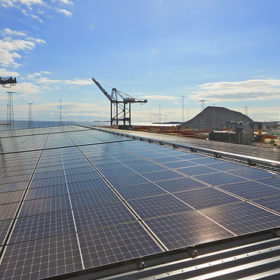
Swedish port offers glimpse of eco-building future with all structures rooftop solar ready
A 605 kW array installed on the roof of the port’s largest building helps prove the claim made by Stockholm Norvik that all of its structures are able to host rooftop solar.

The weekend read: Bridging the BIPV gap
Architects and construction companies are being offered an ever-growing array of Building Integrated Photovoltaics (BIPV) products, with their needs for safety, speed of construction, and aesthetics in mind. But can it drag BIPV beyond niche status?
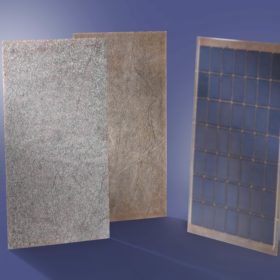
Facade BIPV modules designed with stone veneers
Developed by a German group of scientists, the panels are considered an ideal solution for aesthetically demanding applications in buildings with stone facades. Although their power yield is more than halved compared to conventional modules, the modules can also be used as partial shading walls or semi-transparent roof elements.

The weekend read: Don’t be afraid of BIPV
Necessity, as it’s said, is the mother of invention. For architect Samira Jama Aden, who plays a central role at Helmholtz-Zentrum Berlin’s BAIP consultancy for building-integrated photovoltaics (BIPV), the need for solar to be part of our built environment is becoming unavoidable. And for Aden, her mission is personal.
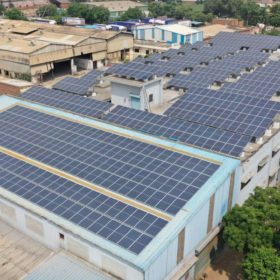
Commercial and industrial rooftops in India could deploy 1,875 MW of solar in 2021
According to a new report, India’s commercial and industrial sectors will increase their rooftop solar deployments by 47% year-on-year, with bifacials and large-size high-wattage modules offering cost-effective support for reducing electricity costs.
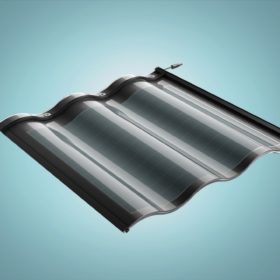
Canadian BIPV module supplier unveils two solar tiles
Both products are based on 22%-efficient CIGS solar cells and are manufactured in Asia. One of the two devices has a flat design and power output of 80 W and a second product features a nominal power of 30 W and an undulating design.
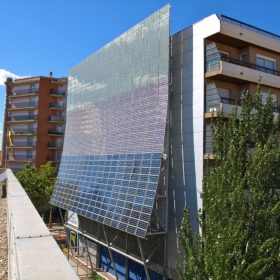
PCM-based passive cooling for BIPV systems
Indian scientists tested four kinds of phase change materials (PCMs) for solar module cooling in building-integrated photovoltaics. The PCMs were encapsulated with the PV system and the building envelopes and were also found to be beneficial to the thermal comfort inside the buildings.

Australia’s ‘largest’ solar facade
Victorian-based property developer Beulah has announced its soon-to-be-completed Paragon tower, in the heart of Melbourne, will be home to the nation’s largest and most efficient vertical solar PV system.
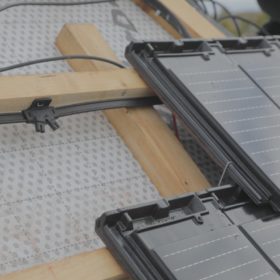
Solar tile made in Germany
German manufacturer Autarq is selling its solar tiles at a price ranging from €25 to €30 per piece. It claims a PV system built with these products can cover around 70% of household needs.
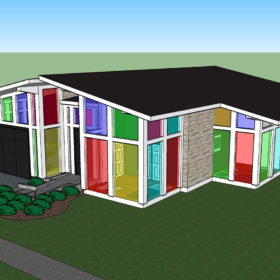
Solar window based on luminescent solar concentrators
U.S. scientists have put luminescent solar concentrators in a windowpane to absorb certain light wavelengths and transmit them to solar cells. The concentrators are made of a conjugated polymer sandwiched between window layers.
