
Photovoltaics for sea cucumber aquaculture
Scientists in China have conducted a year-long study on six “aquavoltaics” farms hosting sea cucumber aquacultures under the solar panels. Due to the lower water temperature, the hibernation period of the animal was reduced, as was mortality, compared to the previous year.
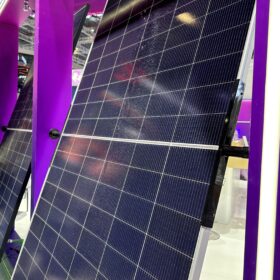
Chinese PV Industry Brief: CGN New Energy awards 10.5 GW of panel deals
China General Nuclear (CGN) New Energy has awarded contracts for 10.5 GW of solar modules under its 2025 procurement framework. The winning companies, including JinkoSolar, Longi, and GCL SI, will supply high-capacity n-type bifacial and monofacial panels.

Four-step method to evaluate rooftop PV potential based on system layout, economic parameters
A Chinese research group has created a novel method to calculate city-scale rooftop PV potential not only based on roof areas but also including installation parameters and economic feasibility. The novel methodology was demonstrated in Nanjing, east China, and was found to be superior to conventional methods when it comes to estimating planned capacity.
China to switch from FITs to market-oriented renewables pricing
China will replace its feed-in tariff (FIT) system with a fully market-driven renewable energy pricing model by June 2025, shifting wind and solar projects to competitive bidding and market transactions. The reform aims to enhance competition but raises uncertainty over future returns for investors.
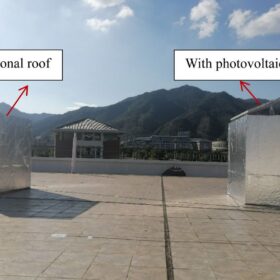
New research suggests optimal tilt angle, overhead height for rooftop PV systems
Researchers in China have investigated the effect of the overhead height and tilt angle on thermal and energy-saving performance of photovoltaic roof and have found that the comprehensive energy-saving efficiency of parallel overhead photovoltaic roofs are optimal in summer and the worst in winter.
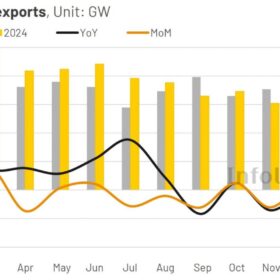
China exports 235.9 GW of solar panels in 2024
China exported 235.93 GW of PV panels in 2024, a 13% increase over the previous year. Of this, 94.4 GW were shipped to Europe, down 7% from 2023.
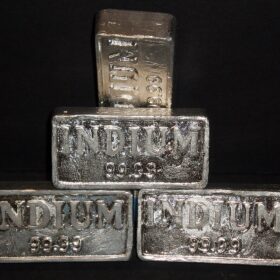
China imposes export controls on critical minerals for thin-film PV
China has announced new export restrictions on materials essential for the thin-film solar industry, including critical minerals such as tungsten, tellurium, and indium.
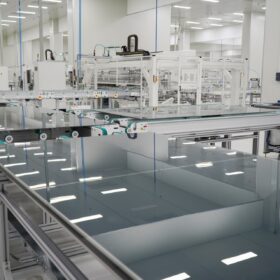
Chinese PV Industry Brief: UtmoLight starts perosvkite module production
UtmoLight says it has launched the world’s first gigawatt-scale perovskite solar module production line at a facility in Wuxi, China. The plant will annually produce 1.8 million panels, with a target of achieving 20% efficiency in mass production by 2025.
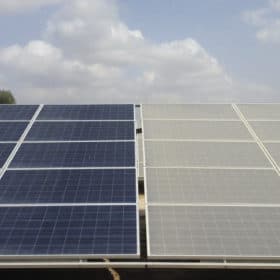
Pressurized water cleaning can improve PV generation efficiency by 10%
Researchers in China have investigated the dust-scaling process and various water-based cleaning methods to optimize maintenance strategies for enhanced safety and efficiency in PV systems.

Aluminum foils can reduce temperature in double-glass PV modules by 6 C
Scientists in China placed a 0.5 mm thick aluminum foil between the solar cell and the EVA, and between the EVA and the glass layer. The two experimental modules were compared to a reference module and were found to dissipate heat and increase the in-plane temperature uniformity.
