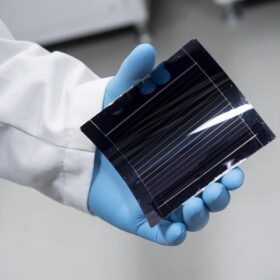
Why CIGS solar keeps lagging behind crystalline silicon
In an interview with pv magazine, Empa scientist Mirjana Dimitrievska explains that the CIGS photovoltaic technology, while promising for efficiency and flexible applications, faces persistent challenges in scaling lab-level performance to cost-effective, high-throughput industrial production, limiting its ability to compete with crystalline silicon. She also emphasizes that long-term stability, reliability, and material sustainability, rather than peak efficiency, are crucial for commercial viability, especially in niche markets like building-integrated and lightweight PV.

Flexible front cover tested for glass-free CIGS devices
Researchers in Japan have developed an effective encapsulation with a PET front cover for copper indium gallium diselenide mini-modules. The lab devices withstood damp heat tests, retaining approximately 97 % of initial efficiency after 3,600 h.
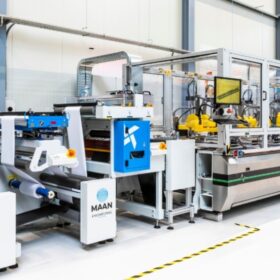
TNO offers mass customization line for integrated PV applications
The Dutch research institute’s highly automated research line offers customized, flexible solar semi-finished PV products to partners developing integrated PV applications.
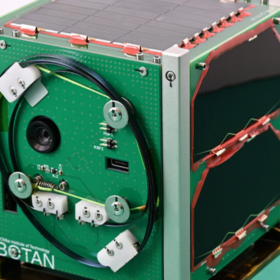
Idemitsu developing CIGS solar modules for satellites
Japan’s oil giant Idemitsu Kosan and U.S.-based Source Energy Company announced a collaboration to develop copper indium gallium-selenide solar modules and arrays for satellite and space applications.

Ascent Solar testing CIGS modules for power beaming, marine applications
The US-based developer of copper indium gallium selenide thin-film PV products said its modules will be tested without modifications by companies developing marine PV and power beaming applications.
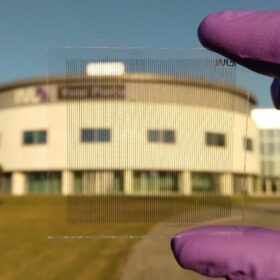
Improving solar windows via microfabrication techniques
Researchers in Europe are investigating semi-transparent solar windows, applying microfabrication technniques to both CIGS and perovskite devices, to overcome the view-impeding properties of earlier solar window concepts.
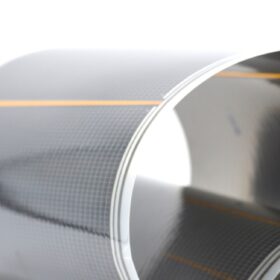
Ascent Solar unveils production scale 15.7% CIGS modules for space
US-based Ascent Solar Technologies says its latest 30cm2 Titan solar module has a power density of 1,960 W/kg and is designed for space applications.
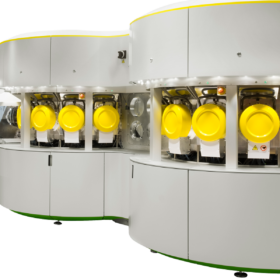
Midsummer bags 15 MW CIGS production line order
Swedish thin film solar specialist Midsummer announced the order of a SEK 143.5 million ($14.8 million) turnkey line with a capacity for 15 MW from an undisclosed Swedish industrial and defense group.
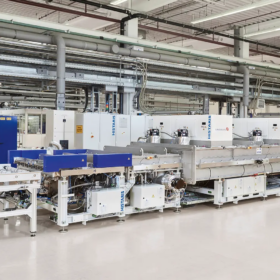
Roltec plans CIGS solar module factory in Poland
Germany’s Singulus Technologies will provide three of its physical vapor deposition (PVD) vacuum sputtering systems to Poland-based module manufacturer Roltec at a new plant that will produce copper, indium, gallium, and selenium (CIGS) cells on glass substrates.
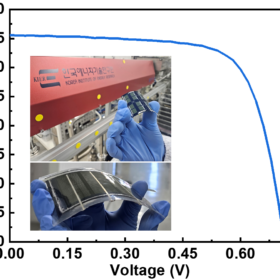
CIGS cell with ultra-thin glass substrate hits record efficiency of 17.81%
South Korean researchers have fabricated a copper indium gallium selenide (CIGS) solar cell with a 90 μm-thick UTG provided by South Korea’s Unique Technology Integral. The device uses a cadmium-free buffer layer made of zinc oxide and magnesium oxide, instead of cadmium sulfide.
