Improving solar windows via microfabrication techniques

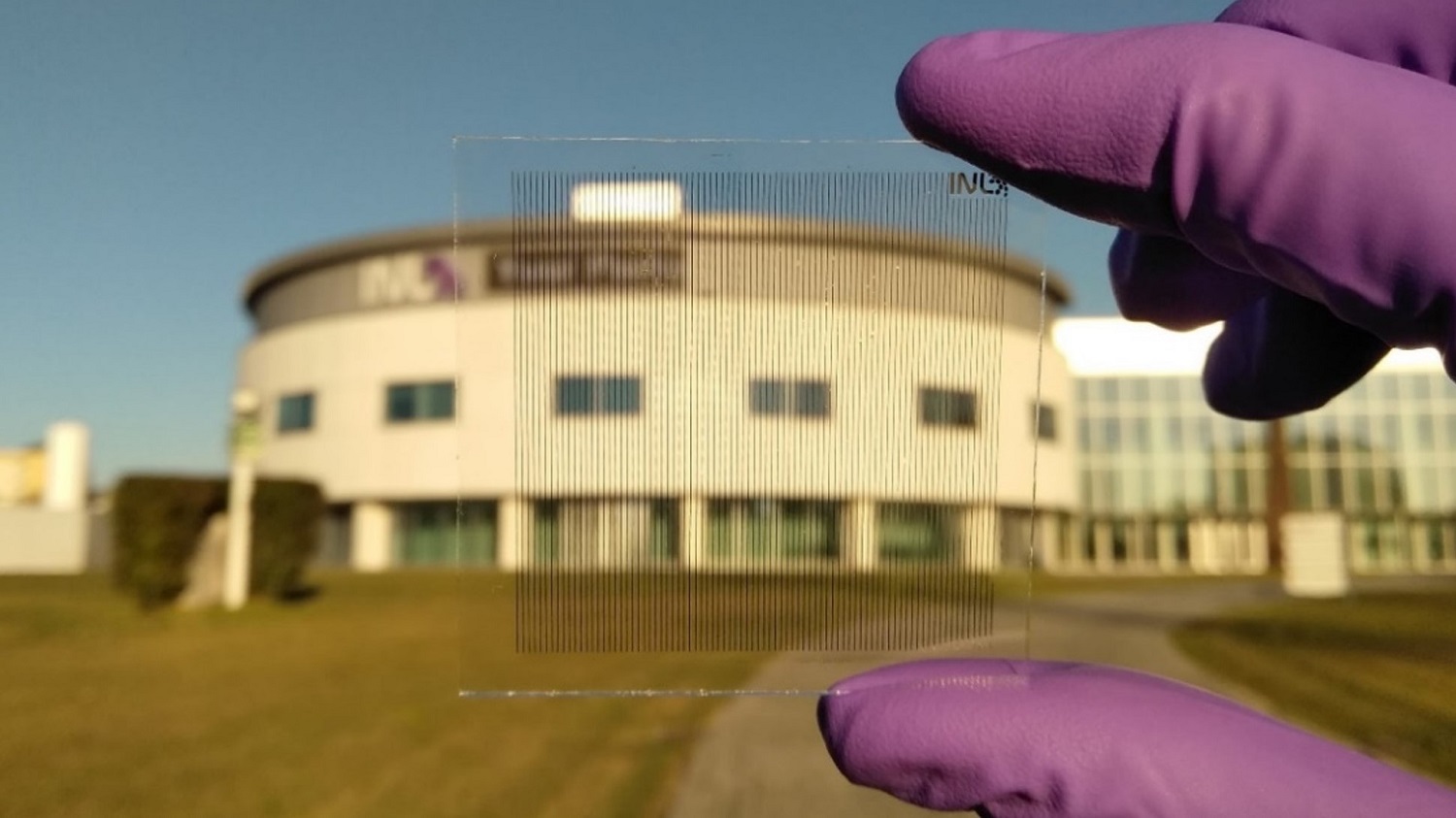
A European team is investigating a new type of thin film solar PV window that relies on microfabrication techniques to overcome the view-impeding opacity and unwanted coloring of earlier solar window designs. The goal is a novel building integrated PV (BIPV) technology that can be deployed in any building as glass windows and glass façade tiles.
In a three-year €1.08 million ($1.27 million) project, the team is investigating using micro-striped solar cells on glass using copper indium gallium selenide (CIGS) and halide perovskite thin films. Acknowledging that these technologies have a power conversion efficiency of greater than 20% in the opaque form, the researchers’ aim is for semi-transparent PV mini-modules with an 8% efficiency at 50% transparency.
Solar windows are meant to combine three functions: as building material, they transmit sunlight into the building; as power generators, they convert solar energy into electricity; and as thermal regulators, they block infrared radiation, reducing undesired heating, according to Pedro Anacleto, Transmit project coordinator at the International Iberian Nanotechnology Laboratory (INL) in Portugal.
“Current STPV solutions that harvest energy from the visible spectrum are either view-impeding, or have an inherent color, making them unattractive for building integration,” Anacleto told pv magazine, adding low performance and unpleasant colors as additional barriers to acceptance.
The challenges for the team are how to achieve color-neutral transparency without sacrificing performance, and ensure “full-thickness films to maximize both power output and aesthetics.”
The solution proposed is micro-striped thin films, long and narrow solar cell lines, separated by transparent gaps of clear glass to make the PV material “indistinguishable to the human eye” at a certain distance. Such a design offers control over visible light transmission (AVT) and efficiency by varying the spacing of the lines, according to the researchers.
The CIGS version targets a 5 cm x 5 cm device while the halide perovskite version targets a 10 cm x 10 cm device. The microstructured CIGS on glass will be formed using photolithography to define the pattern of micro-lines, sputtering, and lift-off techniques, while the perovskite material will be printed using ablation to form the micro-lines.
Despite the project having a technology readiness level 5 (TRL 5), all the fabrication methods were selected because they are scalable and compatible with industrial processes. The TRL measures the maturity of technology components for a system and is based on a scale from one to nine, with nine representing mature technologies, ready for full commercial application.
“The fabrication of these PV devices is the same as for regular opaque CIGS and perovskite solar cells, except for the additional fabrication steps required to make them semi-transparent. Those are standard fabrication processes used in the semiconductor industry, so the equipment is available,” said Anacieto.
The project, dubbed Transmit, includes a lifecycle analysis (LCA). It runs from December 2023 to December 2026. It is funded under the European Clean Energy Transition Partnership (CETP).
Other organizations participating in the Transmit project include the National Interuniversity Consortium of Materials Science and Technology (INSTM), University of Genova, and University of Rome Tor Vergata, all based in Italy, along with the University of Cyprus, Hungary-based Bay Zoltán Nonprofit Ltd. for Applied Research, and Turkey’s ODTÜ-GÜNAM Center for Solar Energy Research and Applications, part of Middle Eastern Technical University (METU).
This content is protected by copyright and may not be reused. If you want to cooperate with us and would like to reuse some of our content, please contact: [email protected].

Please login to comment