Solar in exchange for desalinated water
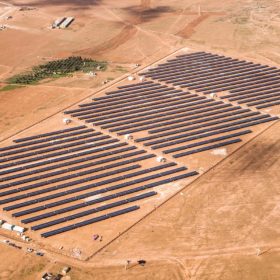
Israel and Jordan have agreed to pair 600 MW of solar with an undisclosed amount of storage. The deal, which was brokered by the United Arab Emirates at COP27, will see Jordan provide electricity to Israel in exchange for desalinated water.
Alfanar to build 110 MW of solar for desalination plant in Saudi Arabia
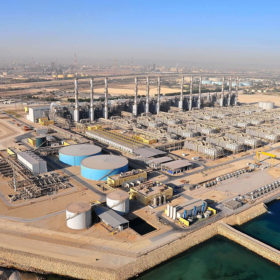
Alfanar has revealed plans to set up a solar project including ground-mounted and floating PV to provide power to the Al Jubail 2 water desalination plant on the east coast of Saudi Arabia. It will require an investment of SAR 1.2 billion ($319 million).
Solar partly powering world’s largest reverse osmosis desalination plant
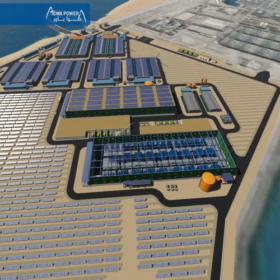
ACWA Power and Emirates Water and Electricity Co. (EWEC) have commissioned the first phase of the Al Taweelah Independent Water Plant in the United Arab Emirates. The facility, which can produce more than 6.4 million cubic meters of water per day, sources some of its power from a nearby solar park.

Renewables desalination for Neom City
The futuristic Neom City will be powered exclusively by renewable energy, but a co-optimization approach with the water sector will be crucial for desalination and sustainable water supplies. Saudi scientists have assessed different system configurations and determined that solar-plus-storage would deliver the lowest levelized cost of energy.

PV-powered portable seawater desalination system for drinking water
US researchers have developed a portable desalination unit that generates clean drinking water without filters or high-pressure pumps. The device is powered exclusively by solar energy and requires just 20 W of power per liter.

Modular PV and wave power desalination buoys from Canada
A floating, reverse-osmosis-based unit turns seawater into potable drinking water through the power of the sun and waves. Oneka developed the product, which requires no external electricity source and no land.
Solar desalination via floating PV in Spain
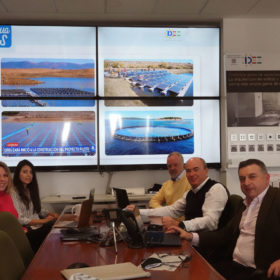
The Agua+S project under development in the Spanish region of Andalucia is aimed at combining a desalination plant, a pumping station network, and an onshore, floating photovoltaic plant in a single project design. According to its developers this is the first time that these three facilities have been combined together in a fully reproducible design that could be replicated in any river basin that has a reservoir and is close to the coast, to produce fresh water for both irrigation and human consumption.

Photovoltaics for multistage flash desalinators
Scientists have investigated how utility-scale solar may be used to power multistage flashing-brine recirculation (MSF-BR) water desalination plants in Aqaba, Jordan. They found the facility would be sufficient to provide the entire city with drinking water. The proposed system configuration comprises a 30 MW solar plant and a standar MSF-BR unit.
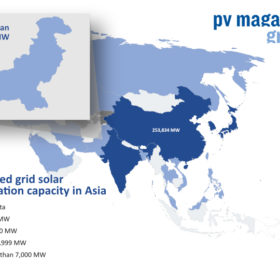
Pakistan’s looming water crisis could be eased by a solar-led energy system
With renewable energy generation said to consume up to 95% less water than fossil-fuel fired power plants, solar could lead the way to a less stressed existence in mid century, according to researchers from Finland’s LUT.
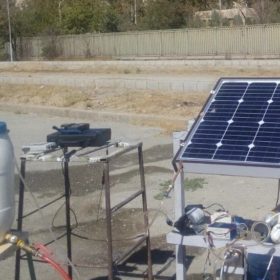
Stand-alone brackish water desalination system powered by photovoltaic-thermal unit
The BWRO unit, which has a treated water production capacity of around 11.80 L/h, was built with a pre-filtration module, a high-pressure DC pump, an RO module, and a post-treatment module. The PVT system was designed to meet the energy requirement of a high-pressure DC pump and a diaphragm-type circulation pump utilized to circulate soft water beneath the PV module for the active cooling of the panel itself.
