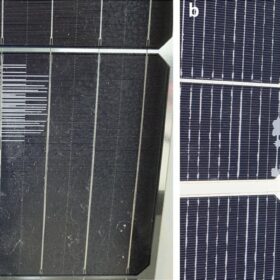
Three-year field test shows TOPCon, HJT solar module reliability in desert areas
A three-year field experiment comparing the performance and reliability of passivated emitter and rear cell (PERC), tunnel oxide passivated contact (TOPCon), and silicon heterojunction (SHJ) modules in desert climates found that HJT modules exhibited the highest degradation, while TOPCon modules showed the lowest degradation.
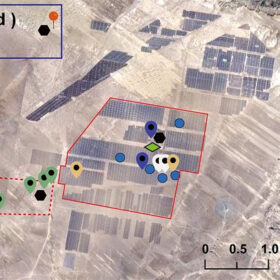
Large-scale PV has positive environmental effect on desert areas
Researchers from China found that big solar power plants have a positive positive impact on the ecological environment of desert areas. Their testing was conducted at a 1 GW solar park located in China’s northeastern Qinghai province.

Scientists unveil desert solar modules with higher performance ratio, reduced temperature sensitivity
Researchers in Morocco have carefully configured and tested a novel desert solar module optimized for harsh desert climates. The new design delivered a 5.8% improvement in performance ratio, a 1.95% increase in efficiency, and reduced temperature sensitivity by 0.85% compared to standard modules.
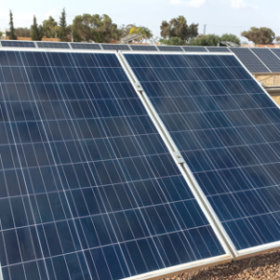
New research finds solar module anti-reflective coatings may reduce LCOE by over 2%
Researchers in Morocco have examined the effects of an anti-reflective coating on solar panel performance under desert conditions and have found that it enhanced both the annual performance ratio and the energy yield by 2% and 5.5%, respectively. They have also found it to be durable and able to withstand dry cleaning methods under accelerated testing.

Another one fights the dust
Scientists from Israel have used nanowires to detach particles from the surfaces of solar panels. The proposed microscopic self-cleaning technology is said to raise the efficiency of particle removal with hydrophobicity.

India plans 55 GW of renewables capacity along Pakistan border
An AFP newswire report this week said Ministry of New & Renewable Energy secretary Anand Kumar had announced plans for 30 GW of generation capacity in the state of Gujarat and 25 GW in Rajasthan, all of it along a 20-25km strip of semi arid land on the border.
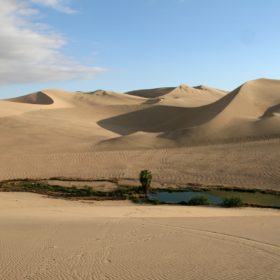
An oasis of PV
A new study shows solar may help reduce water pumping costs in a desert oasis of Mauritania significantly while reducing water losses. Researchers claim PV water pumping may also help prevent desertification.

The weekend read: The science of soil
Soiling and solar: No two solar plants are ever the same, and the conditions that can impact energy yield can literally change with the wind. Soiled solar modules had long been considered a minor nuisance for the sector, but as understanding of how soiling affects output improves, so have techniques and technologies to tackle the persistent problem of dirty modules.

Netherlands’ DSM develops new sand-resistant solar glass
The Dutch specialty group believes its sand-resistant coating for solar panels will be particularly suitable for desert areas. The new technology is currently being tested at a solar plant in China’s Gobi Desert.
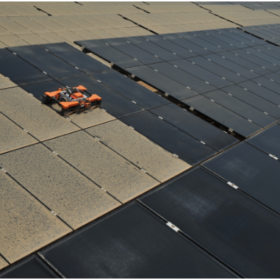
Miraikikai launches water-free solar module cleaner at WFES
Miraikikai’s offering is the first water-free and automated cleaning robot for utility-scale solar plants, which could help solve the challenge of dust in arid regions and deserts, which can be a real problem for plant energy generation rates.
