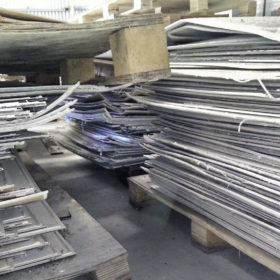
More than 5,000 tons of modules collected for recycling in France
PV Cycle has said it collected more than 280,000 solar panels at the end of their lifecycle in France last year, including 200 tons from the nation’s overseas territories.

EDF seeks mounting structure providers
The renewable energy unit of the French energy giant has made a public call to source mounting structures for the large scale PV projects it wants to build in France up to 2023.
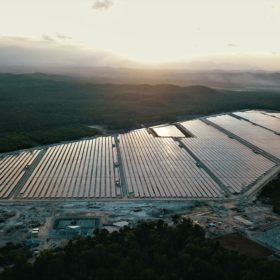
Scatec Solar secured 300 MW of solar capacity in 500 MW Tunisia auction
The Norwegian PV developer was allocated three of the five projects available in the procurement exercise, having reportedly offered to accept $0.025/kWh from utility Société Tunisienne de l’Electricité et du Gaz for the clean power produced by the largest, 200 MW slice of generation capacity available.
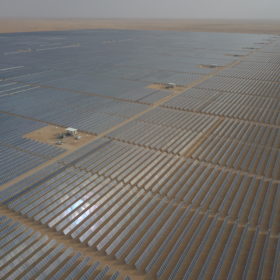
Saudi Arabia’s 300 MW Sakaka solar plant comes online
The PV facility was completed a month and a half ahead of schedule by Saudi energy company ACWA Power. The project will sell power at $0.0236/kWh.
EDF invests in Egyptian renewables developer KarmSolar
The French energy group has injected an unspecified sum into KarmSolar, which has a 165 MW solar project portfolio in Egypt. The developer specializes in power purchase agreements and solar distribution contracts with large commercial, agricultural and industrial clients.
European Utility Week: ‘The confidence is coming back’
The energy transition is becoming ever more apparent among power companies, as was evident at the European Utility Week event last week in Paris, which showcased the hopes and fears of energy companies. Rebranding next year to ‘Enlit’, the organizers aim to reach the whole energy industry.
EDF Pivots towards bigger electric vehicle and storage activity
The French energy giant has acquired U.K. start-up Pivot Power, which has a 2 GW pipeline of storage projects in Britain.

Eswatini 40 MW solar tender attracts 13 approved bidders
The regulator received 26 proposals overall for a project intended to make the kingdom less dependent on power imports from troubled South African utility Eskom.
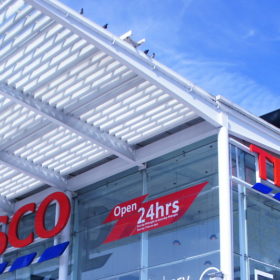
EDF secures a slice of UK supermarket Tesco’s corporate solar plan
The French energy giant will provide supermarket Tesco with electricity from 17 rooftop PV installations and two wind farms for a renewables portfolio generation capacity of 59 MW. The groceries retailer has announced plans to install 187 solar rooftops.
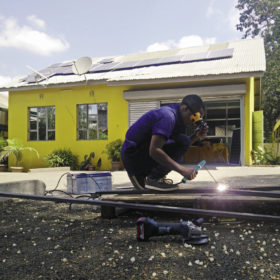
The weekend read: A bump in the road for pay-as-you-go solar and self-sustainability
Two high-profile bankruptcies this year could serve as a warning for the potential pitfalls of pay-as-you-go and small scale, off-grid solar. However, Marcus Wiemann and David Lecoque of the Alliance for Rural Electrification say such business models can lead to long-term success and have a key role to play in providing power to the 1 billion people throughout the world who still live without electricity.
