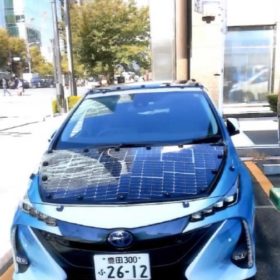
III-V solar cells for PV-powered EV applications
According to a new study from Japan, the global installed PV capacity in solar-powered EVs may reach up to 50 GW by 2030. Its authors claim that solar cells with efficiencies higher than 30%, including multijunction III-V cells and III-V cells combined with silicon cells, are the best candidates for applications in the automotive sector due to the limited space of electric car rooftops. However, a series of technical and economic challenges must still be addressed.
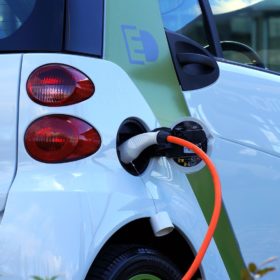
French start-up plans 16 GWh battery factory
Verkor intends to set up a battery fab, with production to start in 2023. The scale could reach 50 GWh, depending on the dynamism of the stationary storage and electric vehicle markets.

Tesla may become power provider in Germany
The high-profile electric car maker is conducting a survey of German customers to gauge their interest in a Tesla electricity tariff.
First image of Tesla’s German Gigafactory unveiled, with rooftop PV to boot
Tesla boss Elon Musk has published the first image of the planned Gigafactory in Grünheide, near Berlin, in eastern Germany.

Hitachi ABB Power Grids launches EV fleet charging system
The containerized product integrates a grid connection with multiple charging systems, enabling electric public transport and commercial fleet operators to charge more vehicles with less infrastructure needed at depots.
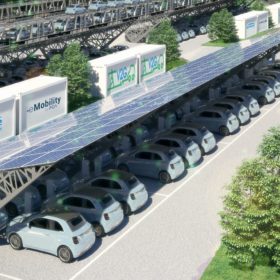
EV batteries providing grid stabilization services at Italian car factory
Fiat Chrysler has begun construction of a vehicle-to-grid pilot at its Mirafiori manufacturing facility in Turin. The project, which also includes 5 MW of PV, will eventually become a virtual power plant.
A Champagne moment for commercial electric vehicles?
Detroit-based Bollinger Motors’ versatile E-Chassis for electric vehicles could pave the way for a commercial vehicle fleet transition in the U.S. which accelerates the e-mobility revolution.
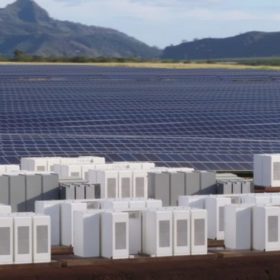
Despite solar woes, Tesla recorded its first profitable Q1
Tesla finished the first quarter of 2020 with a positive GAAP net income, driven by the profitability of the Model Y. However, the story was not so bright for solar, storage or corporate governance.
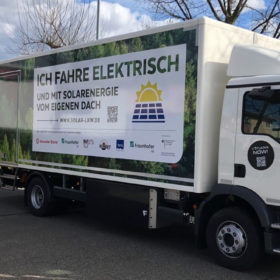
Fraunhofer ISE tests vehicle-integrated PV in commercial trucks
Two Fraunhofer institutes and four industrial players are working together to develop a concept that will facilitate the use of vehicle-integrated solar modules in electric vehicles and trucks. The three-year “Lade PV” project will also focus on PV components and manufacturing processes.
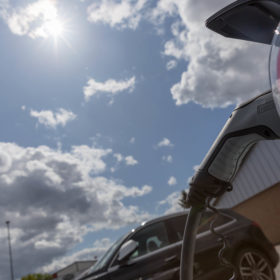
How much money can you make with PV-assisted EV charging stations?
A French-Turkish research team has created an economic model to optimize scheduling for solar-powered EV charging units. The proposed model suggests that such projects might be more profitable today than at the end of the decade, depending on a wide range of variables.
