
Europe has now 8.4 GW of planned and built PV projects under PPAs
A new report from Enervis shows that Spain is currently the most attractive European market for PV projects with a PPA, with 4.39 GW of contracted capacity. Italy and Germany are the second and third markets for this type of project, with 1.91 GW and 1.05 GW, respectively.
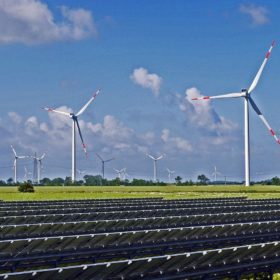
Choosing the best site for wind and solar with fuzzy logic
An international research team is proposing a fuzzy logic approach for optimal site selection of large-scale wind, solar and hybrid wind-solar power projects. The new methodology is based on criterial components for energy optimization through climatological, topographic and human factors.

Solar secures just 5 MW in Italy’s first 500 MW renewables auction
Only one 5 MW solar project was selected in the 500 MW auction, while wind project developers secured the remaining 495 MW. Final price for the selected solar park was €60/MWh.
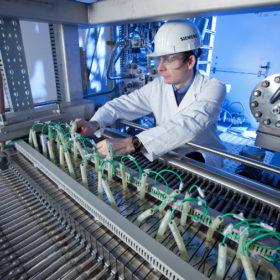
Green hydrogen costs projected to decrease by up to 60% by 2030
A new report from Hydrogen Council predicts that the cost of renewable hydrogen production will fall drastically by up to 60% over the coming decade due to the declining costs of renewable electricity generation and the scaling up of electrolyzer manufacturing. Thanks to its optimal renewable resources, Australia will be among the countries most favorably placed to contribute to the development of the hydrogen economy.
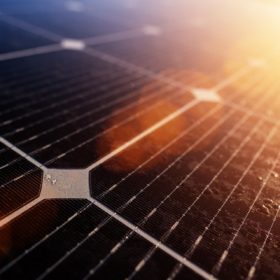
Raising the efficiency of polycrystalline cells with new luminescent EVA film
Chinese researchers have developed a pure EVA film, which they claim can enhance the conversion efficiency of conventional crystalline solar cells by around 0.50%. The film is able to convert UV light into strong visible light.
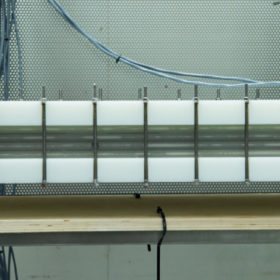
Zinc-air battery aims for extremely low $45/kWh cost
New York state has chosen Zinc8’s zinc-air battery to demonstrate the technology’s viability over a three-year period in a 100 kW/1 MWh storage system.

Spain reaches 8.7 GW of cumulative solar
The country saw the addition of 3.975 GW of new solar installations last year. Most of this capacity comes from solar projects selected by the Spanish government in the renewable energy auction held in July 2017.
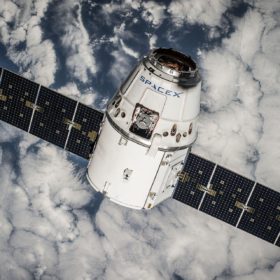
A new approach to performance simulation of heterojunction III-V solar cells
Scientists from Italy are proposing a new theoretical approach based on the combination of the scattering matrix method (SMM) with the Hovel method. The new model is said to describe with improved accuracy the propagation of electromagnetic waves in solar cells based on indium gallium phosphide (InGaP), indium gallium arsenide (InGaAs) and germanium (Ge), taking into account the interference effects. In their view, with proper antireflective coating III-V solar cells can reach efficiencies of more than 50%.

Zimbabwe set for real solar growth
The government has decided to implement a proper independent power producer development plan for large scale PV, with the help of the World Bank.
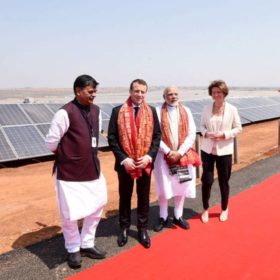
Engie sells controlling stake in 813 MW Indian solar portfolio
This transaction is part of Engie’s develop, build, share and operate strategy which involves selling part of its stake in renewables assets while carrying out operations and maintenance.
