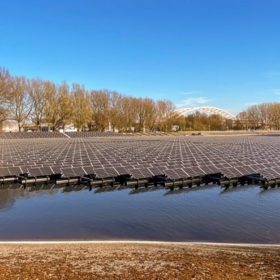
Another floating solar park goes online in the Netherlands
Dutch water supplier Evides Waterbedrijf has commissioned a 1.6 MW floating PV plant at one of its facilities near Rotterdam. It is now considering the construction of more floating solar plants on three other reservoirs, including a 350-hectare water surface.
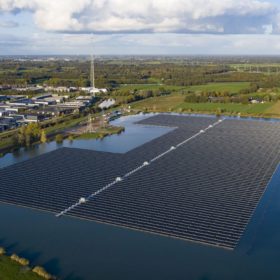
Implementing standards in floating PV
Norwegian consultancy DNV GL has gathered together big energy players, floating PV specialists and project developers into a consortium that will aim to define recommended practices for the floating solar business. Among the 14 participants are some big players in the field including EDP, EDF and Equinor, as well as French floating technology provider Ciel & Terre.
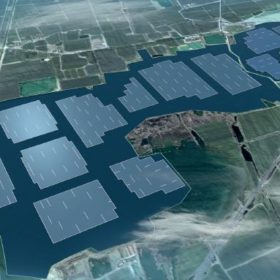
Asian buoyancy floats solar
Global floating PV installations are set to jump by 143% from 2019 to hit more than 900 MW of annual capacity additions this year, according to IHS Markit’s Floating PV Report – 2020. Growth has been driven in recent years by a surge in the number of floating PV systems installed in countries such as China, South Korea, Japan, and the Netherlands, with total global installed capacity reaching about 1.5 GW at the end of 2019. IHS Markit Research Manager Cormac Gilligan and Senior Analyst Chris Beadle examine how these countries have taken the lead, with developers building large quantities of floating PV, while also installing pilots to better understand the technology and test its capabilities and cost-effectiveness.
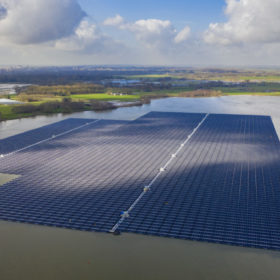
Baywa’s plans for floating PV
Over the past two years, German renewables business Baywa re has developed in-house floating solar technology and installed nearly 50 MW of projects in the Netherlands. Benoît Roux, director of solar activities at Baywa re in France, said the ramp-up in project size has enabled the company to achieve dramatic cost reductions.

Offshore vs land-based solar
A simulation by Utrecht University researchers indicated North Sea PV projects may perform better than a ground-mounted solar generator in the Netherlands. Offshore installations could generate 12.96% more power per year, according to the findings of the study, with the sea acting as a cooling system.

A 25-year power purchase agreement for 60 MW of floating solar in Singapore
Utilities and marine company Sembcorp Industries has secured an energy offtaker for its Tengeh Reservoir project.
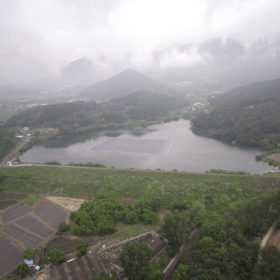
The weekend read: South Korea’s floating ambition
Every summer, millions flock to a festival in the city of Boryeong, 200km south of Seoul. The community offers visitors the chance to strip down and cake themselves in mud from the local tidal flats – a key geographic feature of the Korean Peninsula’s west coast. Another 50 km to the south lies the Saemangeum Seawall – the world’s longest manmade sea dyke, and the planned site of a massive 2.1 GW, state-backed floating PV installation.
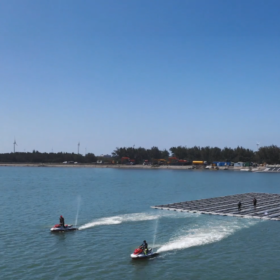
Financial close for 181 MW floating PV plant in Taiwan
The installation will be located in the Changbin Lunwei East district. A NT$7.2 billion loan was secured from a consortium of seven banks and the solar facility is expected to be grid-connected this year.
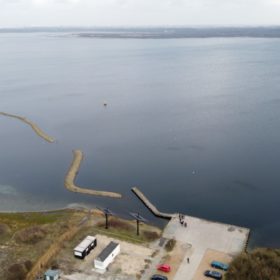
Waves, wind & floating PV
Dutch research center TNO is setting up a test facility for floating PV plants in Oostvoornse, where it will analyze the impact of wind and waves on floating structures and module yield. TNO Senior Project Manager Jan Kroon told pv magazine that it will assess module damage and the impact of waves on light absorption. It has already found that the ratio between wave-height and wave-length is a key factor in mismatch losses, while noting that optimizers and micro-inverters on panels could mitigate losses.

Utility-scale floating PV for Indian coal mines
Solar Energy Corp. of India has tendered two floating PV projects with a combined capacity of 15 MW. The two plants will be deployed at a storage reservoir (10 MW) and an open-cast project void (5 MW) in the Indian state of Telangana.
