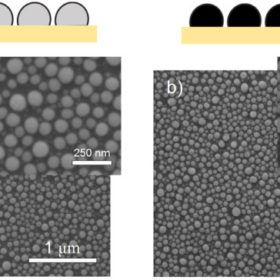
Nanostructured antireflective coating for gallium arsenide solar cells
A Spanish research team demonstrated a broadband antireflective coating for gallium arsenide solar cells. Based on thermally oxidized gallium nanoparticles, the nanostructured coating reduced reflectance by 30% across the solar spectrum, and increased solar cell performance by 10%.
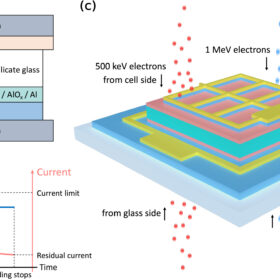
Gallium arsenide solar cells radiation-resilient for space applications
A group led by Cambridge University has developed an adhesive-free method of bonding ultra-thin gallium arsenide solar cells to borosilicate glass. The proposed technique is reportedly compatible with standard planar device processing.
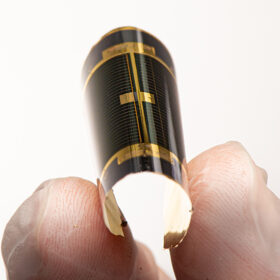
Single-junction III-V solar cell based on spalled GaAs substrate achieves 26.9% efficiency
NREL researchers used acoustically spalled gallium arsenide substrate that reportedly reduces electrical shunting, resulting in potentially lower manufacturing costs. The cell achieved an open-circuit voltage of 1.061 V, a short-circuit current density of 29.9 mA/cm2, and a fill factor of 84.9%.
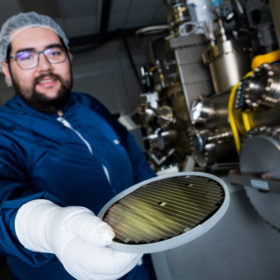
Germanium use reduced in GaAs solar cells by new two-step process
Researchers from Canada have unveiled a new germanium deposition process which is said to eliminate threading dislocations and be significantly cheaper than previous approaches. The scientists say their technique creates nanovoids on the surface of the germanium layer which can attract and annihilate undesirable dislocations.
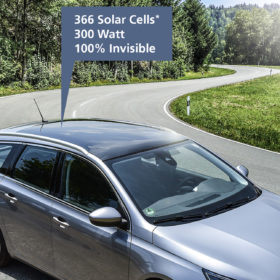
Fraunhofer ISE displays colored solar car roof at auto trade fair
An increasing number of carmakers and research institutes are developing concepts that combine e-mobility and solar. Thus far, range additions from in-car panels of between 10 and 60km are the limit of innovation. The Fraunhofer roof is tinted with a color that hides the cells but lets through most of the light.
