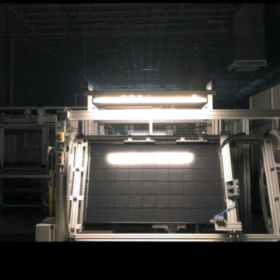
Hurricane Maria moves Solartech Universal’s expansion to South Florida
Solartech Universal plans to expand its current 80 MW/year capacity by 180 MW/year. The company is seeking a facility in South Florida.
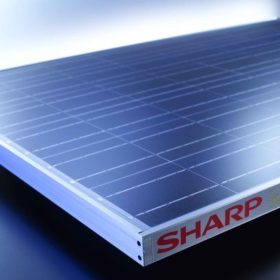
Sharp hits 25.09% efficiency on full size HJT cell
Japanese electronics giant, Sharp has announced the achievement of a 25.09% conversion efficiency, from a cell utilizing both heterojunction (HJT) and back contact technology. The measurement has been validated by Japan Electrical Safety & Environment Technology Laboratories (JET).
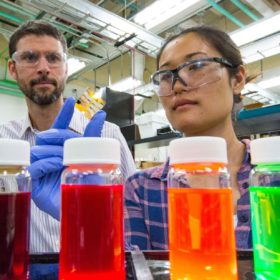
NREL hits new efficiency record for quantum dot cell
Scientists at the U.S. Department of Energy’s National Renewable Energy Laboratory (NREL) have created a solar cell using colloidal quantum dots, which achieved 13.4% conversion efficiency – a new world record for this emerging technology.

Meyer Burger scores 200 MW bifacial HJT supply deal in Italy
Meyer Burger has signed a deal to supply 200 MW of bifacial heterojunction (HJT) solar production equipment to an undisclosed Italian PV manufacturer, in a deal valued at roughly CHF 45 million ($45.4 million).

KAUST researchers look into lateral heterojunction
A team from King Abdullah University of Science and Technology (KAUST) in Saudi Arabia has published research into heterojunction solar cells using alternative materials to silicon. The researchers hope that the process they developed could simplify the fabrication of solar cells.
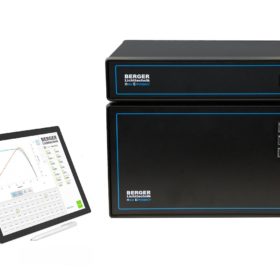
Flasher trends at EU PVSEC
Discussion about the adaptation of standards for Flashers, and the way in which high-performance and bifacial modules should be measured goes on. Berger Lichttechnik is now launching a new cell tester and Halm reports a three-digit number of delivered cell testers.
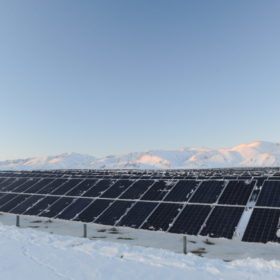
Russia: Hevel completes construction of 20 MW solar park
A 20 MW solar project featuring heterojunction modules is the first one of its kind in Russia. Hevel announces further expansion of its HJT module production to 220 MW.
Panasonic to stop PV production at factory in Japan
Panasonic has decided to stop producing PV modules at a factory it owns near Kyoto, Japan.

3SUN hosts AMPERE launch meeting
Funded by the EU with €14 million ($14.9 million), the AMPERE project was launched at Enel Green Power’s PV module manufacturer 3SUN’s headquarters in Catania, Sicily. Further funding of €14.1 million currently under evaluation.
Hevel producing heterojunction solar cells with Singulus technology
The Russian PV manufacturer aims to produce 160 MW of heterojunction solar cells annually at its fab in Novocheboksarsk. Hevel says it has upgraded its production from thin-film to crystalline modules.
