
The solar module surplus: EUPD Research considers Europe’s warehouse woes
As solar module prices continue to drop to record lows, amid global oversupply, questions are being asked about how much inventory is sitting in European warehouses and when normal levels will return. With numerous estimates and assumptions swirling, EUPD Research’s Markus A.W. Hoehner and Ali Arfa have looked closely at the numbers in an attempt to provide a transparent view of the issue.
PERC inventor discusses the future of the technology
University of New South Wales academic Aihua Wang is the first female recipient of the United Kingdom’s Queen Elizabeth Prize (QEPrize) for Engineering, after sharing the 2023 award with Andrew Blakers, Martin Green, and her husband Jianhua Zhao for their work developing the passivated emitter rear contact (PERC) solar cell. pv magazine caught up with her to ask about the achievement.
A survival guide for solar SMEs
As solar manufacturing moves toward technological convergence, and rampant production capacity expansion continues, standing out from the crowd is just one of the strategies small- and medium-sized enterprises (SMEs) will have to use to survive, according to InfoLink’s Amy Fang.
Weekend Read: Getting to the bottom of TOPCon degradation
Should the industry be alarmed at the potential degradation susceptibility of tunnel oxide passivated contact (TOPCon) solar cells? Or are the problems easily addressed and more a reflection of rushed-to-market products? pv magazine contributor and consultant Götz Fischbeck reports.
Oxford PV sets 28.6% efficiency record for full-size tandem cell
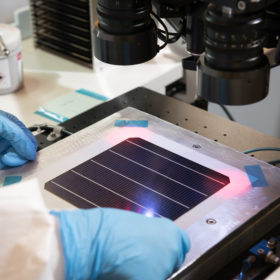
Oxford PV, a leading perovskite solar pv company with operations in England and Germany, achieved power conversion efficiency of 28.6% for a two-terminal perovskite-silicon tandem cell measuring 258.15 cm² cell: A world record for a device based on a ‘full size’ silicon wafer. The record was certified by Fraunhofer Institute for Solar Energy Systems (Fraunhofer ISE).
High hopes for heterojunction
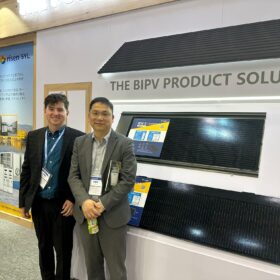
In recent months, China’s Risen Energy has posted impressive module efficiencies, closing in on 24%, with its hyper-ion series. The company will ramp up to large-scale production of these heterojunction products in the first half of 2023, and pv magazine recently caught up with Risen Energy’s Chief Information Officer Terry Wu to discuss this, as well as the company’s work on energy storage projects.
Get what you pay for
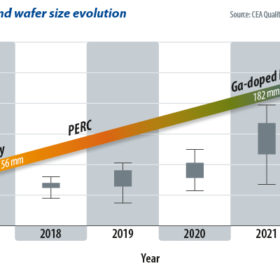
Clean Energy Associates (CEA) has calculated the price premium that solar developers will swallow in return for the levelized cost of energy (LCOE) savings offered by the latest generation of high-efficiency PV panels.

Why solar needs to slim down on silver
New research from UNSW in Australia outlines the need for solar cell and module makers to reduce or eliminate the use of silver in their products. Based on expected PV growth, in line with climate change commitments, solar manufacturers would require at least 85% of global silver reserves, according to the new study.

pv magazine Award 2022 winners
Hopefuls from 40 different countries submitted entries to the pv magazine Awards in 2022, with more regions represented than ever before. This reflects the industry’s increasing global relevance and the importance all regions are placing on local innovation and production. Here we present the seven winners, who will be honored once again in a live Award ceremony on Jan. 17th, staged alongside the World Future Energy Summit in Abu Dhabi and as part of the 11th MESIA Solar Awards Ceremony.
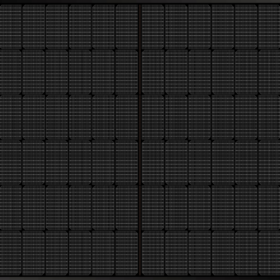
Huasun launches 400 W all-black heterojunction solar module with 21.96% efficiency
The new product is available in five versions with a power output of 380 W to 400 W and a power conversion efficiency ranging from 20.86% to 21.96%. It also features a temperature coefficient of -0.26% per C.
