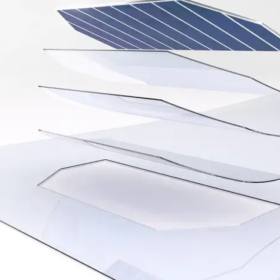
Schott launches new space solar cover glass
The German specialty glass and materials manufacturer announced a new cerium-doped solar cover glass that is compatible with a range of space solar cell technologies, including III-V and silicon-based concepts. It was developed for use in multiple satellite orbits.

Standardized testing for indoor PV
Researchers at Simon Fraser University in Canada have proposed protocols for standardized testing to avoid skewed results. The validated recommendations cover procedures for key measurements and the use of the indoor PV reference cell method.
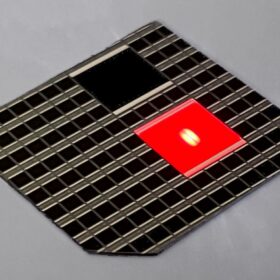
Fraunhofer ISE achieves 40% efficiency for indoor III-V solar cell
The PV device is based on a indium gallium phosphide absorber with an energy bandgap of 1.9 eV. It is intended for use in autonomous Internet of Things (IoT) applications that operate indoors without an external wired power supply.
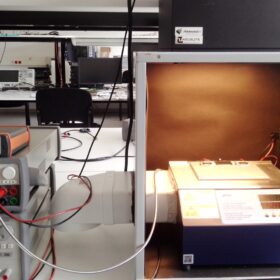
Artificial light tests for indoor PV
Researchers at the Universitat Politècnica de Catalunya in Spain evaluated 12 PV devices from 11 suppliers for indoor use, identifying several systems capable of powering remote sensor nodes with a 10 cm² surface area and advancing to testing under natural indoor light.
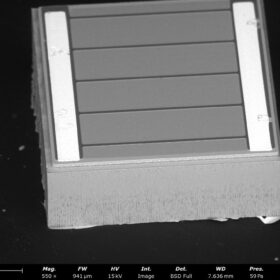
Canadian scientists build micro III-V solar cells with record-breaking open circuit voltage
The proposed cell is based on indium gallium phosphide (InGaP), indium gallium arsenide (InGaAs) and germanium (Ge) and has an active area of 0.25 mm2. It can be used for applications in micro-concentrator photovoltaics (CPV).
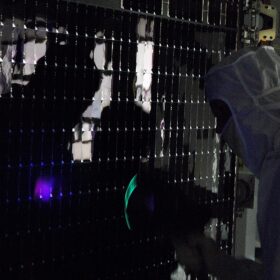
The impact of temperature on III-V solar cells
Scientists in Spain have analyzed the impact of temperature and spectral conditions on III-V solar cells employed in concentrator photovoltaic modules. They claim to have assessed the cell behavior under unprecedented operating condition.
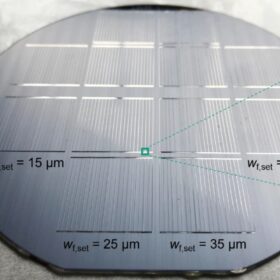
III–V triple-junction solar cell with mask, plate front metallization achieves 31.6 % efficiency
Fraunhofer ISE researchers utilized a new front metallization technique to produce a III-V gallium arsenide solar cell. For mask and plate front metallization, they used a new two-step printing scheme that reportedly allows for the realization of extremely narrow mask openings.
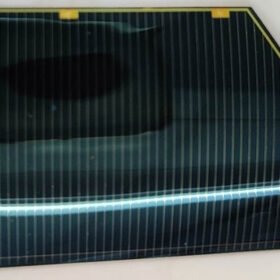
Five-junction III-V solar cell with 35.1% efficiency
Chinese researchers have used metal-organic chemical vapor deposition (MOCVD) to produce a 12 cm2, five-junction solar cell with a minimal number of mismatch dislocations. The cell has an open-circuit voltage of 4.727 V, a short-circuit current density of 860 mA/m2, and a fill factor of 86.38%.
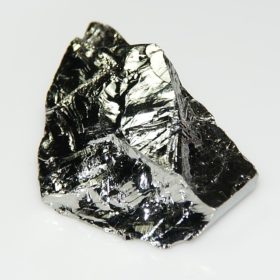
III–V solar cell based on spalled germanium substrate achieves 23.36% efficiency
US scientists used spalled germanium instead of gallium arsenide, as the former reportedly reduces several issues associated with GaAs spalling. The cell achieved an open-circuit voltage of 1.019 V, a short-circuit current density of 28.49 mA cm−2, and a fill factor of 80.45%.
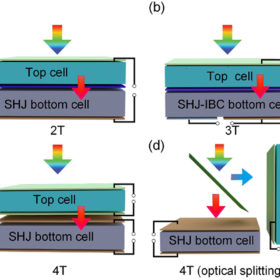
An overview of heterojunction solar cell technologies
Scientists at the Nankai University in China have provided a comprehensive overview of current research on silicon heterojunction-based tandem solar cells (SHJ-TSCs) and shared their expectations of future developments in this field.
