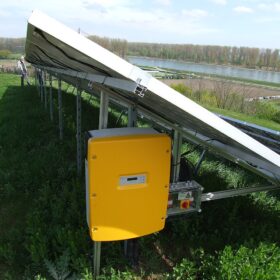
Sinovoltaics releases latest PV inverter manufacturer ranking
The quality assurance firm updated its inverter manufacturer financial stability ranking with APSystems (Yuneng Technology), Sinexcel, and Eaton in the top three spots.

Novel MPPT method combines APO, model-predictive control
An international research team has tested a hybrid control technique combining adapted perturb and observe (APO) with model-predictive control to address complex partial shading in solar arrays. The method, validated through simulation and physical experiments, reportedly outperforms existing approaches.
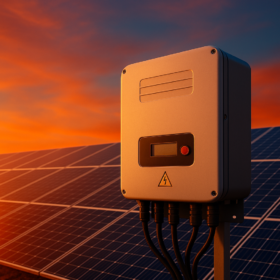
Cooling PV inverters with skived fin heat sink
Researchers in Turkey tested a novel heat sink design to cool insulated gate bipolar transistor (IGBT) arrays in solar inverters. They found that it reduced module temperatures by more than 6 C in lab experiments.

Novel switched capacitor boosting inverter for PV usage
Researchers have designed a new switched-capacitor-based multilevel inverter topology with nine switches. They have tested it in simulations and in hardware-in-the-loop tests. Efficiency reached up to 96.5%.

Tigo introduces solar inverter output control for system repowering
Limiting inverter output, called derating, enables installers to maintain system power rating when adding a new inverter to an existing solar installation, or to help homeowners qualify for incentives with precise power targets.

Chinese PV Industry brief: GCL Optoelectronics raises $27.5 million for perovskite factory
GCL Optoelectronics Materials has raised nearly CNY 200 million ($27.5 million) in a C2 financing round to advance perovskite solar manufacturing and research at its new gigawatt-scale facility in China’s Jiangsu province.
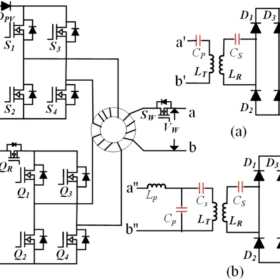
Wireless EV charging based on PV, three-port DC–DC converter
Scientists have developed a wireless charging system for electric vehicles, with a three-port DC–DC converter at its core. They have simulated the system and tested a prototype in their lab and have found it achieved an improved efficiency of 88%.
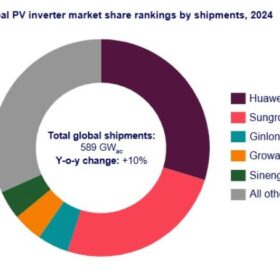
Huawei leads global inverter market as shipments hit 589 GW in 2024
Chinese companies made up nine of the 10 largest global inverter suppliers in 2024, with total inverter shipments reaching 589 GW (AC), according to Wood Mackenzie.

Netherlands increasing vigilance on solar inverter-related cybersecurity risks
The Dutch government said it remains vigilant on potential cybersecurity threats coming from solar inverters. It minimized, however, the risk of hidden hardware components in inverters and said these devices would be “easily detectable” by the Dutch authorities.

EU adopts state aid framework for cleantech industry
The European Commission has developed a new state aid framework under the Clean Industrial Solutions Act for Europe (CISAF) to support clean technology manufacturing across the European Union.
