
Key takeaways from Abu Dhabi’s World Future Energy Summit
WFES 2026 in Abu Dhabi underscored growing momentum for solar, storage, and C&I renewables across MENA, with batteries emerging as a key enabler for grid stability, agriculture, and data centers. Industry leaders pointed to Iraq, Libya, Yemen, and Saudi Arabia as key growth markets, highlighting rising interest in AI-driven data centers, solar-plus-storage solutions, and a broadening regional supply chain.
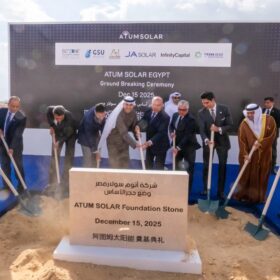
JA Solar joins consortium building $210 million PV module factory in Egypt
The 200 square meter facility is targeting an annual manufacturing capacity of 2 GW of solar cells and 2 GW of solar modules. The solar cell production will be 100% for export.

Solar advances across MENA region
The fossil fuel rich Middle East and North Africa (MENA) region faces mounting pressure to diversify its energy mix. While solar is cheap, it faces significant sociopolitical and economic challenges.
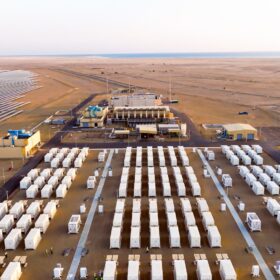
The MENA region – the next hot market for energy storage!
“The MENA region – the next hot market for energy storage?” I asked in an article back in October 2017. It took a bit longer than I expected, but seven years later it’s time to replace the question mark with an exclamation mark. It’s hot indeed.
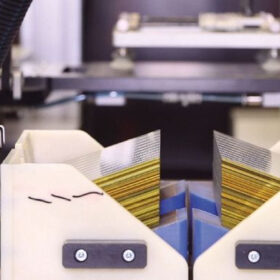
A gulf between PV ambition and testing facilities
Though it already hosts several of the world’s largest PV installations, the Middle East and North Africa (MENA) region’s solar industry is still young, with limited local infrastructure and expertise. Project developers are learning quickly that building PV in harsh desert environments requires a careful eye on quality. New testing laboratories are looking to meet demand.
Middle East, North Africa to hit 40 GW of solar this year
The Middle East Solar Industry Association’s (MESIA) latest Solar Outlook Report says that despite rapid growth in solar deployment across the Middle East and North Africa, the area’s power mix is still dominated by fossil fuels. It says growth will be led by utility-scale solar, but it calls for a balanced approach involving distributed energy projects.
IFC says green recovery could drive $2.5tn renewables market this decade
The private-sector arm of the World Bank, which claims to leverage $3 of its own capital and $8 from third parties for every dollar invested in its blended finance funds, has attempted to quantify what devoting Covid recovery funds to green investment would mean for emerging economies.
World could add more than 900 GW of solar by 2025 if politicians grasp the nettle – IEA
With the International Energy Agency publishing its latest five-year clean energy forecast today, pv magazine takes a look at the solar content of the 162-page document.

Algeria plans 4 GW of solar tenders
The government has announced a plan to deploy new PV capacity at a mega site over the next four years. Around 800 MW of capacity is expected to be tendered annually up to 2024. To be eligible, it is anticipated all modules, cables and mounting structures must have been made in Algeria.
Egypt evaluating solar desalinators
The government has signed a memorandum of understanding with Saudi energy company ACWA Power to conduct a feasibility study for an unspecified volume of renewables-powered desalination projects.
