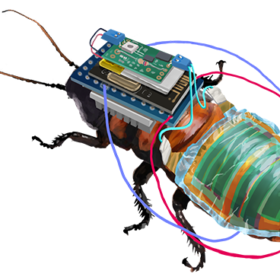
PV-driven rechargeable control module for ‘cyborg cockroaches’
Japanese researchers have built ultra-soft PV devices and ultra-thin electronics that can be placed on the curved abdomens of cockroaches without affecting their mobility. The system can be used to monitor hazardous areas, or for urban search-and-rescue operations.
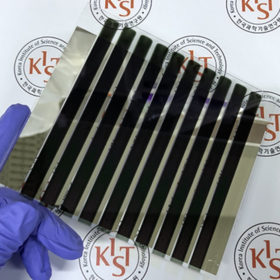
Large-area organic solar cell with 14.7% efficiency
Scientists in Korea built an organic solar cell that is reportedly able to prevent aggregation in photoactive layers. The device could be used for applications in buildings, vehicles, and the Internet of Things.
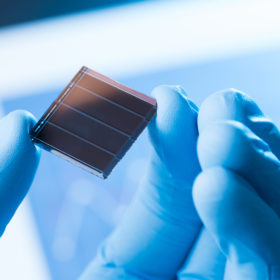
Femtosecond lasers for high-efficiency organic PV
UK scientists have developed a process using laser and x-ray pulses to observe what happens in the initial fractions of a second after light hits a solar cell. By applying the technique to various organic PV materials, they expect to gain insights that could quickly the improve the efficiency of such materials.
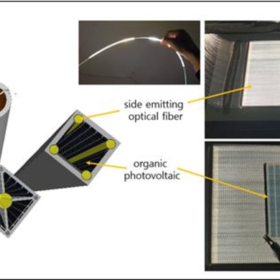
Vertical optical-fiber solar cell hybrid system from South Korea
South Korean scientists have built a vertical three-dimensional fiber-optic solar-cell system with greater maximum efficiency than planar solar modules, as well as a lower surface requirement.

BIPV facade for new exhibition space in Switzerland
Switzerland-based Novartis has deployed a 36 kW building-integrated PV facade on its new exhibition center in Basel. The system features 10,680 organic PV modules from France’s Asca.
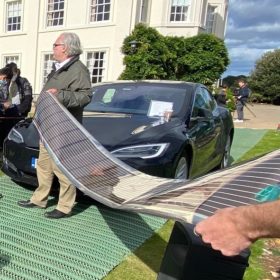
Printed solar panels for Tesla’s journey around Australia
Commercially printed solar cell technology developed by the University of Newcastle is being put to the test to power an electric vehicle’s 15,097-kilometre journey around the entire coastline of Australia.
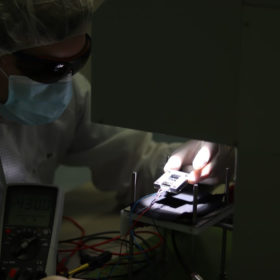
Ultra-thin perovskite-organic tandem solar cell with 24.0% efficiency
Researchers in Germany have built a perovskite-organic solar cell with low interfacial losses and a high open-circuit voltage. The device achieved an open-circuit voltage of 2.15 V, a short-circuit current of 14.0 mA cm−², and a fill factor of 80%.
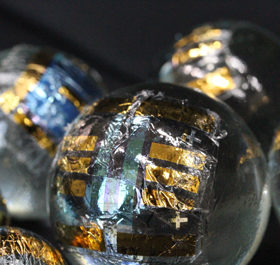
Photovoltaics for curved surfaces
Researchers in Japan have used heat-shrinkable polymers to laminate organic photovoltaics onto curved surfaces. The process improves efficiency while minimizing damage to photovoltaic components.

All-polymer organic solar cell with 16.05% efficiency
The device achieved the highest efficiency and fill factor ever reported for an all-polymer solar cell based on polymerized small molecular acceptors. The cell was built with a top donor material known as PBDB-T and an electron acceptor made of the polymer PYT.
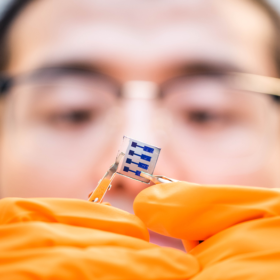
Green solvents for a 17%-efficient organic solar cell
Scientists in Sweden and China developed a solution-based process to produce organic solar cells, demonstrating efficiencies better than 17%. The process utilizes paraxylene as a solvent, which the researchers claim is less toxic and more stable than others used to reach high organic solar cell efficiencies, and with more work could be scaled up to produce large area devices.
