
Perovskite-silicon tandem solar cell based on wide-bandgap top device achieves 33.10% efficiency
Researchers in China have integrated a wide-bandgap perovskite solar cell with a hybrid back contact device in a four-terminal tandem cell that achieves high efficiency and stability. Key for the strong performance was a new surface passivation strategy that the research group adopted for the top cell.
Scientists design 30.22%-efficient perovskite-silicon tandem solar cell with heterojunction bottom tech
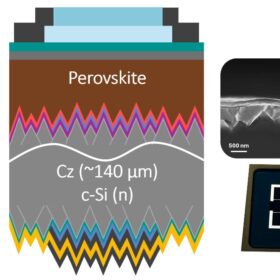
An international research team has developed a perovskite-silicon tandem solar cell with a hole transport layer based on methyl-substituted carbazole and submicron-sized textured silicon bottom heterojunction cells. The proposed cell configuration uses commercially available Czochralski silicon wafers and promises efficiencies over 30%.

Perovskite-silicon tandem solar cell based on indium oxide buffer layer achieves 30.04% efficiency
Researchers in China have fabricated a perovskite-silicon tandem solar cell that utilizes an indium oxide sputtering buffer layer to protect the perovskite absorber and the electron transport layer from potential damages arising from the electrode deposition process. The new layer not only ensured this protection but also showed strong optical and electrical properties.
Perovskite-silicon tandem solar cell based on copper(I) thiocyanate achieves 31.46% efficiency
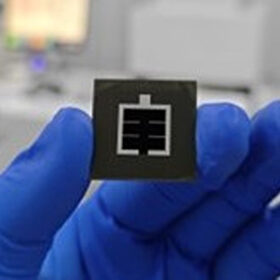
A Saudi-Chinese research team has fabricated a perovskite-silicon tandem solar cell without a hole transport layer (HTL) in the perovskite top cell. This innovative strategy, based on the co-deposition of copper(I) thiocyanate and perovskite in the top cell absorber, was intended at solving typical issues of HTLs in tandem devices.
KAUST, Helmholtz-Zentrum Berlin present 31.2%-efficient blade-coated perovskite-silicon tandem solar cell
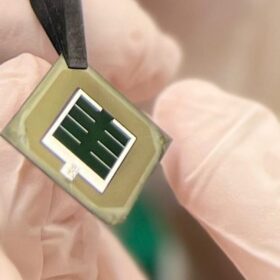
The perovskite-silicon tandem device has a two terminal configuration and a 2D perovskite layers at the bottom interface. It was able to retain around 80% of its initial efficiency for 1,700 h.
Indian researchers present 28%-efficient silicon-perovskite tandem solar cell
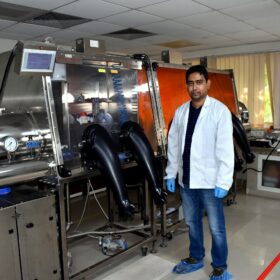
A research group at the Indian Institute of Technology Roorkee has fabricated 4-terminal silicon-perovskite tandem solar cells with power conversion efficiency of 28%. The team is now scaling up this technology to match 18.2 cm x 18.2 cm, commercial M10 solar cells dimension.

Fraunhofer ISE claims 31.6% efficiency for perovskite-silicon tandem solar cell
The German research institute said it utilized a hybrid manufacturing route to deposit the perovskite solar on the cell’s top PV device based on an industrially textured silicon heterojunction technology. For the bottom subcell, a standard silicon solar cell was used.
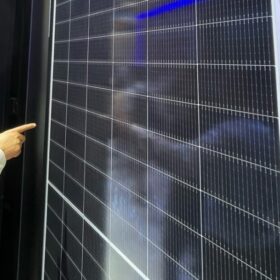
Longi achieves 34.6% efficiency for two-terminal tandem perovskite solar cell prototype
In a paper published in nature, the Chinese module maker explained that the 33.9%-efficient tandem device it unveiled in December 2023 is based on a bilayer intertwined passivation strategy that combines efficient electron extraction with further suppression of nonradiative recombination. It also revealed that its two-terminal tandem prototype devices achieved an efficiency of 34.6%.
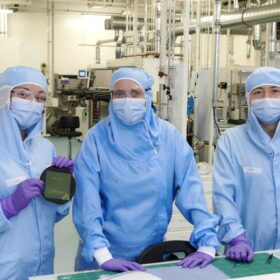
CEA-INES, Enel achieve 29.8% efficiency for tandem perovskite-silicon solar cell
The 9 cm² cell consists of a top cell based on a perovskite absorber and a bottom cell with a heterojunction (HJT) structure. The results improve on the 28.4% efficiency CEA and Enel achieved for the same kind of cell in December.

Scientists set new efficiency target for monolithic perovskite-silicon tandem solar cell
Researchers at the University of Sydney have achieved a 30% efficiency rating with a monolithic perovskite-silicon tandem solar cell and now have their sights set on a new target.
