
Power Roll testing new metrology for perovskite solar
The UK-based perovskite solar PV specialist has announced a new metrology research project with Swansea University and a new development agreement with Renolit, a German plastic films, sheets and polymer solutions company.

Korean scientists build mini perovskite solar module with 22.56% efficiency
GIST researchers have developed a perovskite mini-module with 22.56% efficiency by improving the SnO₂ electron transport layer with PEI, reducing defects and electron loss. The module retained 94% of its performance after 500 hours, highlighting potential for scalable, stable perovskite solar cells and modules.
Chinese startup claims record-breaking 27.87% efficiency for single-junction perovskite solar cell
Shenzhen-based SolaEon has reported a 27.87% efficiency for a single-junction perovskite solar cell on a 0.076 cm² lab device, certified by China’s National Photovoltaic Industry Metrology and Testing Center.
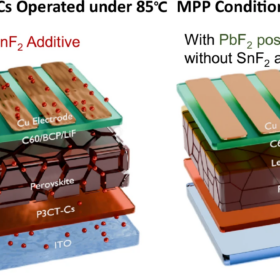
Scientists build tin lead perovskite solar cell with 24.07% efficiency
A Chinese-Swedish research team has boosted the performance of tin-lead perovskite solar cells by modifying additives and post-treatment processes. The device also demonstrated improved stability, retaining 60% of its initial efficiency after 550 hours at 85 °C under maximum power point conditions.

Scientists achieve 32.6% efficiency in perovskite-silicon tandem solar cell via interface engineering
Researchers from KAUST, TU Delft, and LMU Munich have improved the performance of monolithic perovskite-silicon tandem solar cells by modifying the physical structure at the front of the bottom heterojunction solar cell.

Scientists achieve 25.4% efficiency in perovskite solar cells with enhanced stability using multivalent ligands
Researchers have used multivalent amidinium ligands to boost perovskite solar cell efficiency to 25.4%, achieving over 95% stability after 1,100 hours at 85 C. The proposed approach enables controlled low-dimensional passivation layers, offering a practical route for durable, large-area perovskite devices.
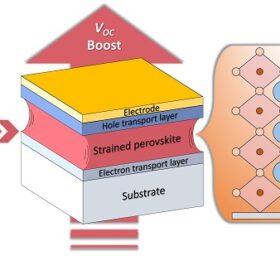
EPFL researchers enhance perovskite solar cell performance via rubidium
Researchers led by Michael Grätzel at the Ecole Polytechnique Federale de Lausanne in Switzerland have recently led efforts to improve perovskite optoelectronic properties using small-radius rubidium ion chemistry to enable more stable and efficient perovskite solar cells.

China National Petroleum Corporation achieves 25.05% efficiency for inverted perovskite solar cell
The Chinese energy and oil company said the cell can be used as a top device in perovksite-silicon tandem configurations. The result was confirmed by the Shanghai Institute of Microsystem and Information Technology (SIMIT).

How to reduce ionic losses in tin-based perovskite solar cells
Researchers in Germany have developed a DMSO-free fabrication process for tin-based perovskite solar cells that dramatically reduces ion density – over tenfold lower than in lead-based devices – leading to improved stability.

Perovskite-silicon tandem solar cell with steric complementary design achieves 32.3% efficiency
Researchers in China developed a monolithic perovskite-silicon tandem solar cell using a steric-complementary interface design, achieving a certified efficiency of 32.12% and enhanced long-term stability. This strategy optimizes molecular fit in the perovskite lattice, improving both charge transport and device longevity.
