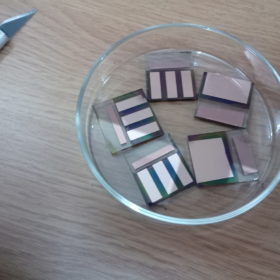
Large area perovskite solar cell with copper metal contact
An Indian research group has built a perovskite cell that has a metal contact based on copper, instead of expensive gold. The device showed almost the same efficiency as a cell developed with gold metallization but its stability was much lower. In order to overcome this issue, the scientists suggest using a metal contact made of a thin layer of gold and a thicker, overlying copper layer.
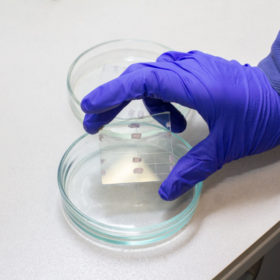
Russian scientists achieve 21.1% efficiency in perovskite solar cell via Mie-resonant silicon nanoparticles
A Russian-Italian research group has developed resonant silicon nanoparticles that are claimed to improve the performance of perovskite solar cells. These particles serve as nanoantennae – they catch light and it resonates inside them, which amplifies the cell’s light absorption.
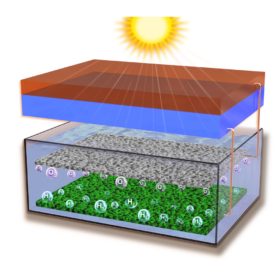
Direct solar hydrogen generation tech powered by 24.3%-efficient tandem perovskite-silicon solar cell
Developed by Australian scientists, the demonstrated system is claimed to achieve a solar-to-hydrogen efficiency of 20% at a levelized cost of hydrogen (LCOH) of $4.10/kg. The direct solar hydrogen generation technology is powered by a tandem perovskite-silicon solar cell with an unprecedented high open-circuit voltage of 1.271 V, and a power conversion efficiency of 24.3%.

Co-evaporated perovskite solar cell with 19.5% efficiency
German scientists have built a perovskite solar cell with spiro-TTB as a hole transport material, via the thermal co-evaporation method. The solar cell has an open-circuit voltage of 1.08 V, a fill factor of 83.0%, and a short-circuit current of 21.6 mA cm.
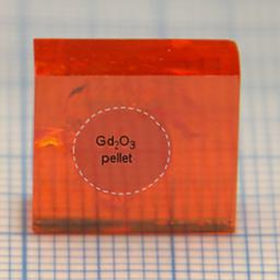
Perovskites can also detect nuclear radiation
Scientists in Switzerland found that perovskites can be used to detect thermal neutrons emitted by radioactive devices. Taking advantage of several properties that also make the materials attractive for solar cell applications, the group was able to fabricate a novel device that could have various practical applications, including in energy generation.
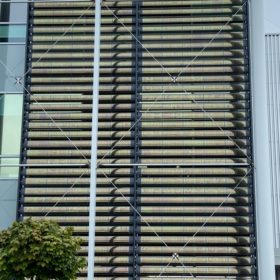
Photovoltaic sunshade based on perovskite solar cells
The phovoltaic sunshade was deployed on the facade of a factory owned by Polish aluminum system provider Aliplast. The movement of the PV blinds is regulated by a controlling system linked to a weather station installed on the roof.
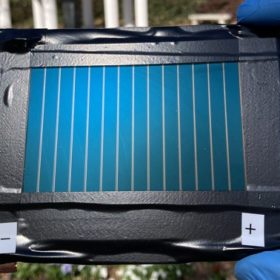
Mini perovskite solar module with 19.2% efficiency via new additive
The efficiency of the module was certified by the U.S.’ National Renewable Energy Laboratory. It was built with perovskite solar cells with a stabilized efficiency of 23.6%, an open-circuit voltage of 1.17 V, a short-circuit current density of 24.1 mA per cm−2, and a fill factor of 0.842.

Perovskite-silicon tandems could rapidly scale solar
Halide perovskites combined with conventional silicon could help solar break the 26% efficiency barrier – disrupting the technology without disrupting business systems.

Ligand-free perovskite quantum dot solar cell with 9.3% efficiency
The quantum dots used for the device are based on methylammonium lead iodide and are synthesized within a porous silica (SiO2) matrix. Compared to its bulk counterparts, the ligand-free solar cell exhibited a more stable performance.
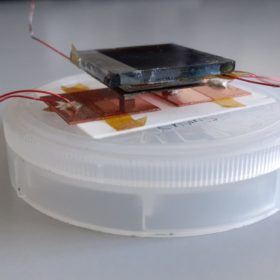
Recovering waste heat from solar cells via a thermoelectric generator
Scientists in Italy have created a hybrid thermoelectric photovoltaic (HTEPV) system based on a thermoelectric generator and a wide-gap perovskite solar cell. The device is able to recover waste heat from the PV unit and produce additional power. According to its creators, this configuration needs large gap cells as these are less sensitive to temperature in terms of efficiency
