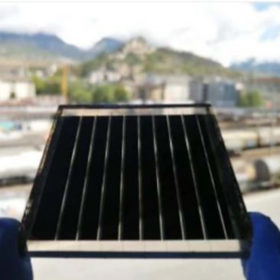
Perovskite solar module with 21.36% efficiency via new passivation tech
Lithuanian scientists built the panel with 23.9% efficient solar cells with operational stability of over 1000 h. The module has an active area of 26 cm2.
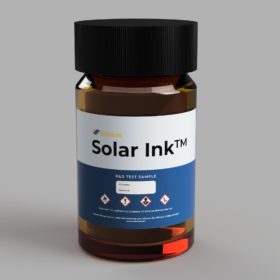
Perovskite ink for flexible solar panels
Developed by a Canadian start-up, Solar Ink can be used to create standalone perovskite solar modules or it can be combined with existing solar modules in a tandem configuration. It can be coated on both flexible and rigid substrates, resulting in translucent solar cells which, in turn, can be used to produce flexible and light modules for application in solar windows and vehicle-integrated photovoltaics.
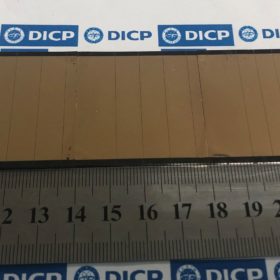
Perovskite solar cell with 24.33% efficiency via ionic liquid capping layer
Developed by scientists in China, the cell achieved an open-circuit voltage of 1.192V, and a fill factor of 80.67%. Its perovskite capping layer was treated with a special ionic liquid that had a positive influence on both the device’s efficiency and stability.
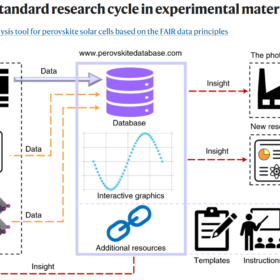
The Wikipedia of perovskite solar cell research
An international team of researchers has collected data on metal halide perovskite solar cells from more than 15,000 specialist publications and made them available in an open-access database. The Perovskite Database Project is based on the FAIR data principles that data should be findable, accessible, interoperable, and reusable and aims to capture the rapid development occurring in this increasingly relevant research field.
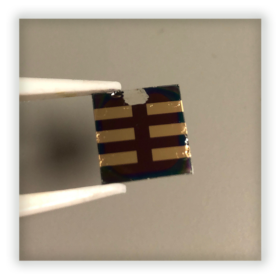
Paired with ‘wonder material,’ over 21% efficiency demonstrated in perovskite solar cells
The use of phosphorene nanoribbons boosted the cell, putting it on par with traditional silicon cell output levels.
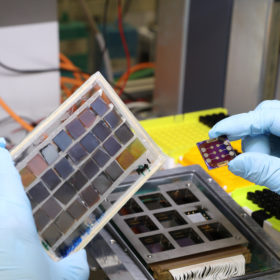
Perovskite solar cell retains 99% of initial efficiency after 1,450 hours
Developed by German researchers, the 20.9%-efficient device was built with an architecture avoiding the use of the ionic dopants or metal oxide nanoparticles that are commonly used to contact the cell, as these can be subject to secondary reactions at higher temperatures.
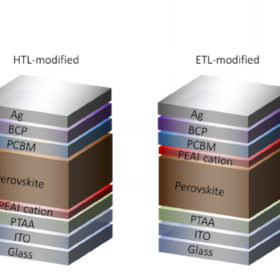
Inverted perovskite solar cell with 23.7% efficiency
A German-Italian research team has designed an inverted perovskite solar cell with a short-circuit current of 1.184 V and a remarkable fill factor of 85%. The device was built by modifying its interfaces with large organic cations.
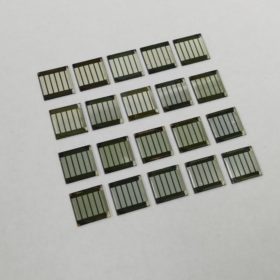
Dion-Jacobson perovskite solar cell with 18.82% efficiency
Scientists in China have used a fused-thiophene spacer to build a two-dimensional perovskite solar cell. It has an open-circuit voltage of 1.03 V, a short circuit current of 22.38 mA cm2, and a fill factor of 81.64%.

Perovskite solar cells for electronic shelf labels
The solar-powered electronic shelf labels are intended for use in retail stores. Users are enabled to change prices centrally and synchronously across all retail stores within a chain.
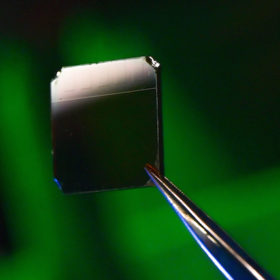
Ultra-thin 2D perovskite solar cell with 18.3% efficiency
The solar cell was built with a layer of organic cations between the iodide on top, and lead on the bottom enhanced interactions between the layers. Its creators designed the device after they discovered that, when the sunlight hits a 2D perovskite, it contracts the space between atomic layers in the material.
