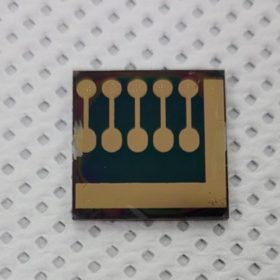
Perovskite solar cell with 19.1% efficiency via CO2 doping
Thanks to a carbon dioxide doping technique, the solar cell interlayers exhibited conductivity around five times higher than that of a perovskite cell based on interlayers doped with oxygen. The device also showed an open-circuit voltage of 1.14 V, a short-circuit current density of 21.2 mA cm2 and a fill factor of 0.79.

CEA-Ines achieves 19.2% efficiency for flexible perovskite solar cell
The cell was fabricated with a flexible substrate made of indium tin oxide (ITO) and polyethylene terephthalate (PET). The device was tested through a damp heat test and showed it can retain around 90% of its initial efficiency after 800 hours.
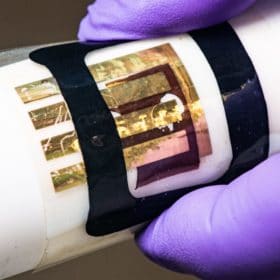
US scientists gain an atom-level view into perovskite cell efficiency
Using Department of Energy laboratories, scientists learned at the atomic level that a liquid-like motion in perovskites may explain how they efficiently produce electric currents.
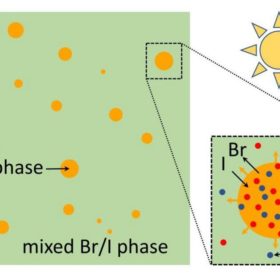
Thermodynamic model to build more-stable perovskite solar cells
Dutch scientists claim to have developed a theory that explains the mechanisms behind halide segregation, which is the main factor affecting thermal stability in perovskite solar cells. They affirmed that the theory may provide technical solutions to build more stable perovskite PV devices.
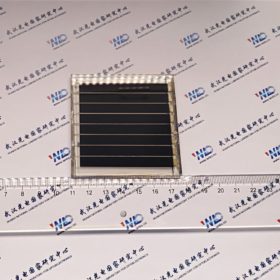
16.63%-efficient perovskite PV module via slot-die coating
Scientists in China have developed a large-area perovskite solar panel by utilizing diphenyl sulfoxide (DPSO) as an electron acceptor. The device was fabricated via slot-die coating, and featured a parallel-interconnection architecture.

A different angle on perovskite defects
Scientists in China took a closer look at the role of defects in limiting the performance of perovskite solar cells, demonstrating a screening effect that could be tuned to make material defects “invisible” to charge carriers, greatly improving cell performance. Using this approach they demonstrate a 22% efficient inverted perovskite solar cell, and theorize several new pathways to even higher performance.
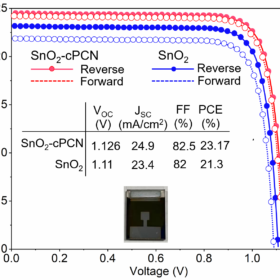
Perovskite solar cell with larger grain size and 23.17% efficiency
The result was achieved for a small area device with the size of 0.1 sq cm. The cell was fabricated with a Tin(IV) oxide electron transport layer modified with crystalline polymeric carbon nitrides (cPCN).

Hair! Coming to a next-generation PV cell near you
Scientists have found that a human hair derivative can protect, stabilize and enhance the performance of perovskite solar cells.
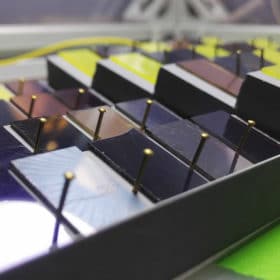
MIT scientists reveal method to identify stable perovskites
U.S. researchers are using a data fusion approach to identify the most stable perovskites for PV cells. Their machine-learning method combines perovskite test results with first-principles physical modeling to identify the best candidates.
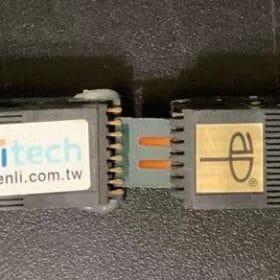
18.3%-efficient perovskite solar cell for automatic light adjustment
Chinese scientists have powered two electrochromic devices with a perovskite solar cell based on a hole transporting material made of poly(triarylamine) (PTAA). The cell has an open-circuit voltage of 1.02 V, a short-circuit current of 22.8 mA/cm2, and a fill factor of 78.4%. When solar radiation is higher, the cells drive the electrochromic devices into a dark state, which in turn reduces the light that can enter a building.
