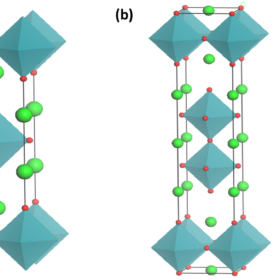
Prospects for Ruddlesden–Popper perovskite solar cells
A research group in the Netherlands has analyzed different manufacturing techniques for two-dimensional Ruddlesden–Popper perovskite solar cells. These cells offer improved photostability and environmental stability compared with their three-dimensional counterparts.

Inverted perovskite solar cell achieves 22.31% efficiency via novel electron-accepting interlayer
A Korean research group has built an inverted perovskite cell that is able to retain 91.7% of its initial efficiency after 1,000 h under standard illumination conditions. They built the device with an electron-accepting interlayer that also acts as charge transport.
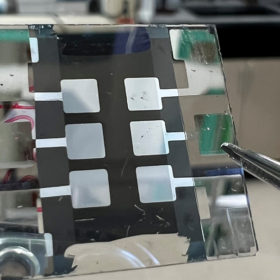
Perovskite solar cell achieves 24% efficiency, retains 87% of output after 100 days
Researchers at the US National Renewable Energy Laboratory claim to have achieved a breakthrough for high-efficiency perovskite solar cells.
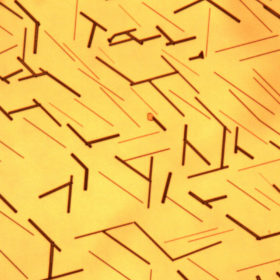
New ferroelectric material for lead-free perovskite solar cells
US scientists have discovered a lead-free perovskite material with ferroelectric properties that can be used in solar cells. The perovskite compound was grown from cesium germanium tribromide and initial analysis shows that it produces ferroelectricity.
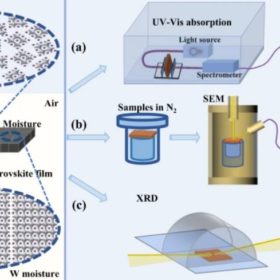
Perovskite solar cell with 23.93% efficiency via new moisture treatment
Scientists from China developed a controllable moisture treatment for perovskite films that is reportedly able to promote the mass transportation of organic salts. The films were used to build a 0.2 cm2 perovskite solar cell that was able to retain 80% of its initial efficiency after 1200 h.
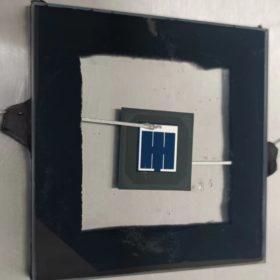
Perovskite-silicon tandem single-cell solar module with 26.2% efficiency
Researchers in Saudi Arabia claim to have reduced cell-to-module losses in tandem perovskite silicon photovoltaic devices through an optical redesign of the module through refractive-index engineering. They built a monolithic perovskite-silicon tandem mini-module with a power conversion efficiency of 26.2%.
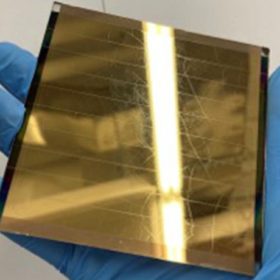
Light-scattering structures to boost solar performance
An international team of scientists developed a nanoparticle structure which, when added to a solar cell, was shown to scatter light and potentially reflect it many times within the cell, contributing to a noticeable jump in current.
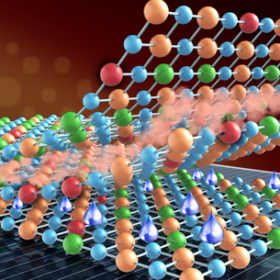
Surface engineering for an 18.6% efficient large-area inverted perovskite solar cell
Scientists in China worked with nickel-oxide as a charge transport layer in a perovskite solar cell, and were able to overcome several of the performance challenges associated with this material through careful surface engineering. Using this approach, the group fabricated an inverted perovskite solar cell measuring 156×156 mm that achieved 18.6% efficiency, along with ‘remarkable’ stability, according to its designers.
Reverse bias – a hidden challenge for perovskite solar cell stability
New research from renowned PV scientist Martin Green and colleagues at UNSW reveals that perovskite solar cells may struggle to deal with reverse-bias caused by uneven shading or other issues likely to appear in the field. Both the reverse-bias itself and resulting build up of heat can cause several of the materials commonly used in perovskite solar cells to degrade, and these issues have received only limited attention in research published to date. Solutions, however, are at hand.
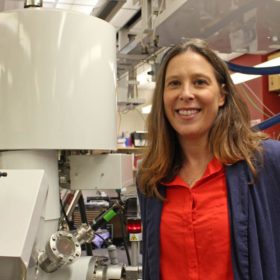
Perovskite solar cell defect characterization during manufacture for improved stability
A novel electrochemical robotic arm is under development at the University of Arizona to identify perovskite defects during manufacturing rather than after to improve durability.
