
CSEM, EPFL achieve 31.25% efficiency for tandem perovskite-silicon solar cell
The new world record was independently certified by the National Renewable Energy Laboratory (NREL) in the United States.
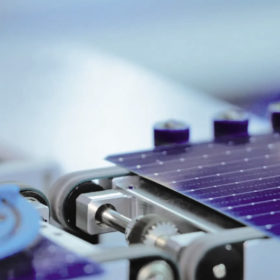
Perovskite-silicon tandem solar cell with TOPCon structure hits 27.6% efficiency
A research group led by Chinese manufacturer JinkoSolar has developed a tandem perovskite-silicon cell with a subcell based on TOPCon tech. The group succeeded in reducing voltage losses in the silicon sub-cell by minimizing the shunting probability during device fabrication.
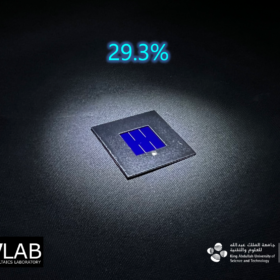
Inverted perovskite-silicon tandem solar cell with 29.3% efficiency
Researchers in Saudi Arabia have built an inverted perovskite-silicon tandem device with a 1 nm thick interlayer based on magnesium fluoride (MgFx). They claim it can stop voltage losses and increase power conversion efficiency, while retaining 95.4% of its initial efficiency after 1,000 hours.
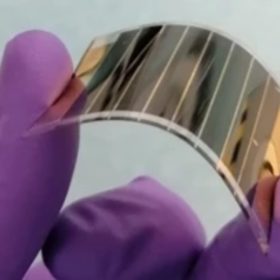
CEA-INES develops 18.95%-efficient flexible perovskite solar panels
French researchers have developed PV modules with an area of 11.6 square centimeters for indoor applications. They said the achieved efficiency level marks a world record for a flexible perovskite device larger than 10 square centimeters.
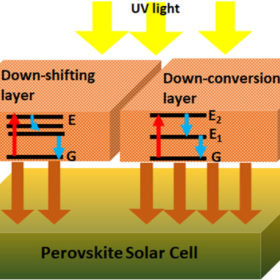
Perovskite solar cells based on down-conversion materials
An international research group has assessed the potential of down-conversion materials to overcome the poor blue response of solar cells. They analyzed how such materials could be used to improve the performance of perovskite-based devices and found that certain advances might be achieved.
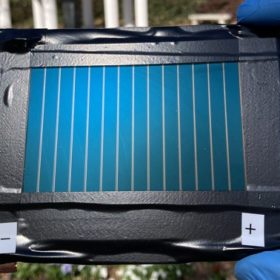
Automatically generated databases for perovskite, dye-sensitized solar cells
University of Cambridge scientists have created new databases for dye-sensitized and perovskite cells, respectively. They used the ChemDataExtractor text-mining toolkit to collect the data.

Large-area graphene-perovskite solar modules with better temperature coefficient
An Italian-Greek research group has developed a large-area perovskite solar panel with graphene-doped electron transporting layers. With increasing temperatures, the module exhibits a smaller drop in open-circuit voltage than commercially available crystalline silicon panels.
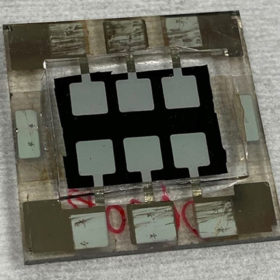
Tandem tin-lead perovskite solar cell with 25.5% efficiency
The US National Renewable Energy Laboratory has made a tandem perovskite solar cell that can retain 80% of its original efficiency after 1,500 hours of continuous operation, or more than 62 days. To improve its stability, they used a hole-transporting material made of phenethylammonium iodide and guanidinium thiocyanate.
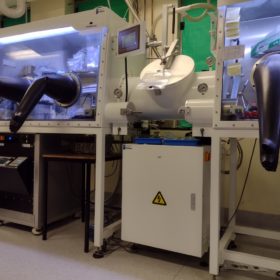
Perovksite solar cell with 23.13% efficiency via new passivation approach
Australian researchers built a perovskite solar cell with guanidinium bromide and octylammonium bromide cations. They claim the device can achieve a higher open-circuit voltage, while exhibiting better efficiency and stability.
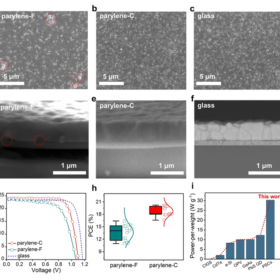
Ultra-thin inverted perovskite solar cell with 20.2% efficiency
Chinese scientists have developed an ultralight solar cell with perovskite film based on a 3-µm-thick polymer. It purportedly has a power conversion efficiency in line with that of perovskite cells of conventional thickness.
