
JA Solar builds inverted perovskite solar cell with 26.7% efficiency
The Chinese manufacturer said the cell uses a multifunctional organic ammonium salt to improve interfacial engineering between the perovskite absorber and the electron transport layers. The device also achieved 24.5% efficiency when scaled up to a 1 cm² active area.

Inverted perovskite solar cell based on self-assembled monolayer achieves 26.92% efficiency
Researchers in China have developed an inverted perovskite solar cell approaching the 27% efficiency threshold. The device incorporates a specially designed self-assembled monolayer that passivates perovskite defects and enhances efficiency.

Outdoor testing identifies factors contributing to perovskite solar cell degradation
Tests conducted by a research team in outdoor environments in Spain and Poland have demonstrated a strong correlation between perovskite solar cell degradation and the combined effects of climatic and operating conditions. The scientists found that open-circuit operation accelerates degradation, whereas operation at the maximum power point and under short-circuit conditions has a lower impact.

US Army tests Swift Solar perovskite tech in deployable microgrid
US-made perovskite tandem cells from Swift Solar were used in a US Department of Defense hybrid microgrid as part of a recent cybersecurity demonstration.
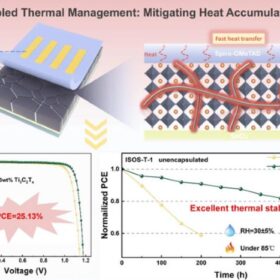
Perovksite solar cell based on MXene achieves 25.13% efficiency
A Chinese research group claims to have achieved remarkable efficiency and stability in a solar cell based on a perovskite absorber incorporating MXene, a novel type of 2D material known for its excellent conductivity, chemical stability, and thermal resilience. The device reportedly retained 80% of its initial efficiency after 500 hours.

Perovskite quantum dot solar cell achieves record-breaking efficiency of 18.3%
Conceived by scientists in China, the cell was built with an alkaline treatment that modulates efficiently the perovskite quantum dots surface chemistry. The device reportedly achieved the highest power conversion efficiency ever reported for this kind of solar cells.
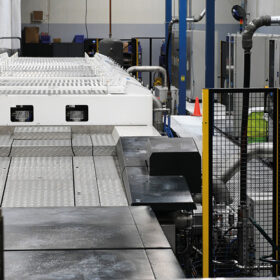
Scaling perovskite tandems’ U.S. prospects
Three US manufacturers actively working to commercialize their respective perovskite-silicon tandem technologies make the case for tandem modules. CubicPV, Caelux and Swift Solar argue a commercial future for perovskites is inevitable, and they tell pv magazine the current policy environment could work in the technology’s favor.

Researchers identify main source of wide-bandgap solar perovskite degradation
Scientists in Belgium have investigated how perovskite absorbers used in solar cell degrade under three different stress test types and have found that the interface between the perovskite layer and the electron transport layer suffers from weak thermomechanical stability, which creates the conditions for performance losses.

First Graphene claims major boost for perovskite solar cell efficiency
Australian graphene supplier First Graphene has reported the addition of its functionalized graphene product to perovskite solar cells has increased efficiency almost two-fold and reduced production costs by up to 80%.
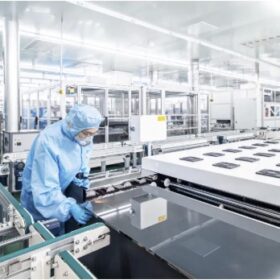
Renshine Solar hits 27.5% efficiency for flexible all-perovskite solar cell
Renshine Solar says it has achieved a record 27.5% efficiency for a flexible all-perovskite cell and 23.0% on a 20.26 cm² panel.
