
Power Roll testing new metrology for perovskite solar
The UK-based perovskite solar PV specialist has announced a new metrology research project with Swansea University and a new development agreement with Renolit, a German plastic films, sheets and polymer solutions company.

Korean scientists build mini perovskite solar module with 22.56% efficiency
GIST researchers have developed a perovskite mini-module with 22.56% efficiency by improving the SnO₂ electron transport layer with PEI, reducing defects and electron loss. The module retained 94% of its performance after 500 hours, highlighting potential for scalable, stable perovskite solar cells and modules.
Chinese startup claims record-breaking 27.87% efficiency for single-junction perovskite solar cell
Shenzhen-based SolaEon has reported a 27.87% efficiency for a single-junction perovskite solar cell on a 0.076 cm² lab device, certified by China’s National Photovoltaic Industry Metrology and Testing Center.
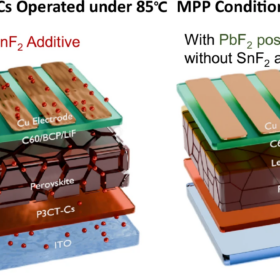
Scientists build tin lead perovskite solar cell with 24.07% efficiency
A Chinese-Swedish research team has boosted the performance of tin-lead perovskite solar cells by modifying additives and post-treatment processes. The device also demonstrated improved stability, retaining 60% of its initial efficiency after 550 hours at 85 °C under maximum power point conditions.

Australian startup moves forward with perovskite solar manufacturing plans
Halocell Energy is set to benefit from the development of a sovereign supply chain for high-purity precursors to perovskite after signing a memorandum of understanding with Queensland advanced materials company Lava Blue.

Scientists achieve 32.6% efficiency in perovskite-silicon tandem solar cell via interface engineering
Researchers from KAUST, TU Delft, and LMU Munich have improved the performance of monolithic perovskite-silicon tandem solar cells by modifying the physical structure at the front of the bottom heterojunction solar cell.

Scientists achieve 25.4% efficiency in perovskite solar cells with enhanced stability using multivalent ligands
Researchers have used multivalent amidinium ligands to boost perovskite solar cell efficiency to 25.4%, achieving over 95% stability after 1,100 hours at 85 C. The proposed approach enables controlled low-dimensional passivation layers, offering a practical route for durable, large-area perovskite devices.

China’s Hefei BOE Solar Technology claims 27.37% efficiency for perovskite solar cell
The Chinese perovskite solar technology developer said the result is currently under testing by an unspecified third-party authoritative laboratory in China. The achievement is part of the company’s efforts to bring its perovskite cell technology closer to commercial production.

China National Petroleum Corporation achieves 25.05% efficiency for inverted perovskite solar cell
The Chinese energy and oil company said the cell can be used as a top device in perovksite-silicon tandem configurations. The result was confirmed by the Shanghai Institute of Microsystem and Information Technology (SIMIT).

Perovskite-silicon tandem solar cell with steric complementary design achieves 32.3% efficiency
Researchers in China developed a monolithic perovskite-silicon tandem solar cell using a steric-complementary interface design, achieving a certified efficiency of 32.12% and enhanced long-term stability. This strategy optimizes molecular fit in the perovskite lattice, improving both charge transport and device longevity.
