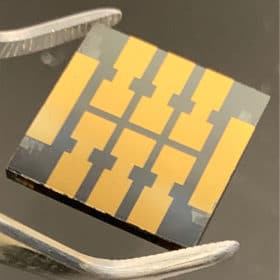
Perovskites stick together for better performance
Scientists in the U.S. demonstrated an additive that acts as a “molecular glue” within a perovskite solar cell. Treating the cells with this self-assembled monolayer material was shown to greatly improve their long-term performance, whilst also providing a boost to conversion efficiency. And the scientists further point out that the treatment relies on simple processing and readily available materials – good signs for its applicability in manufacturing.
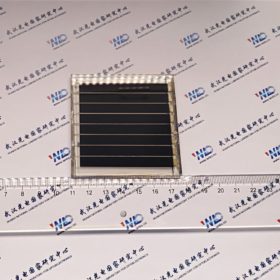
16.63%-efficient perovskite PV module via slot-die coating
Scientists in China have developed a large-area perovskite solar panel by utilizing diphenyl sulfoxide (DPSO) as an electron acceptor. The device was fabricated via slot-die coating, and featured a parallel-interconnection architecture.
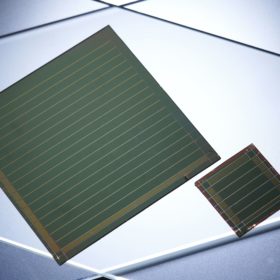
Large-area perovskite solar module with 18% efficiency
Researchers in Germany claim to have overcome the main challenge for the development of large-area perovskite PV modules – scaling up from the cell to the module level. They achieved an efficiency of up to 16.6% on a module surface of more than 50 centimeters squared, and 18% on a module with an area of 4 centimeters squared.
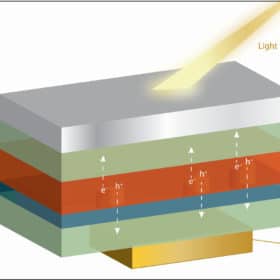
Doping and capping promise perovskite stability
Scientists demonstrated two new approaches to improving the stability of perovskite solar cells. By both incorporating rubidium into the structure of the perovskite, and adding a film of two-dimensional perovskite as a capping layer, they were able to demonstrate a significant reduction in the cell’s sensitivity to moisture. The group says its research will open up new routes to improved performance and stability in perovskite PV.
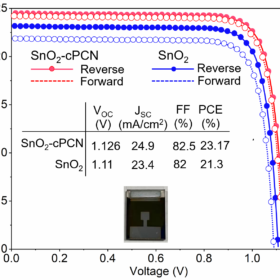
Perovskite solar cell with larger grain size and 23.17% efficiency
The result was achieved for a small area device with the size of 0.1 sq cm. The cell was fabricated with a Tin(IV) oxide electron transport layer modified with crystalline polymeric carbon nitrides (cPCN).
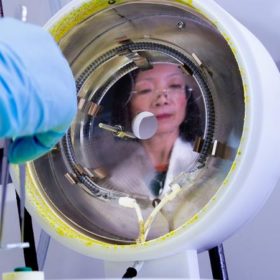
Hair! Coming to a next-generation PV cell near you
Scientists have found that a human hair derivative can protect, stabilize and enhance the performance of perovskite solar cells.
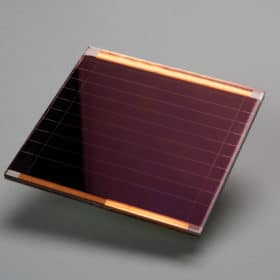
UNIST, EPFL claim 25.6% efficiency world record for perovskite solar cell
Scientists have set a new efficiency record for a single-junction perovskite solar cell at 25.6%. The cell additionally showed operational stability for 450 hours, and intense electroluminescence with external quantum efficiencies of more than 10%.
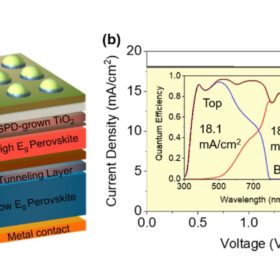
Multi-layer front contact perovskite solar cells with 16.55% efficiency
Japanese scientists have used spray pyrolysis deposition to fabricate perovskite solar cells based on a titanium oxide electron transport layer. They claim that the cells have the potential to reach a power conversion efficiency rating of more than 30%.
MIT scientists reveal method to identify stable perovskites
U.S. researchers are using a data fusion approach to identify the most stable perovskites for PV cells. Their machine-learning method combines perovskite test results with first-principles physical modeling to identify the best candidates.
18.3%-efficient perovskite solar cell for automatic light adjustment
Chinese scientists have powered two electrochromic devices with a perovskite solar cell based on a hole transporting material made of poly(triarylamine) (PTAA). The cell has an open-circuit voltage of 1.02 V, a short-circuit current of 22.8 mA/cm2, and a fill factor of 78.4%. When solar radiation is higher, the cells drive the electrochromic devices into a dark state, which in turn reduces the light that can enter a building.
