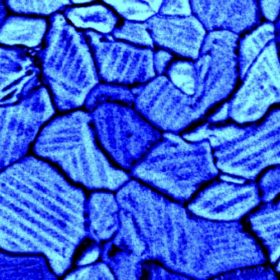
Scientists show hybrid organic–inorganic perovskite is ferroelastic, not ferroelectric
This means that this promising material, contrary to common belief, is able to form domains of polarized strain to minimize elastic energy. The research team made its discovery by using multimodal imaging.
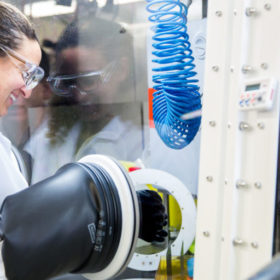
Oxford PV, Oxford University target 37% efficient perovskite solar cells
The solar company has launched a five-year research project with the British scientists, which has been funded with £2.5 million from the U.K. Government. The goal is to develop a thin film multi-junction perovskite solar cell with a 37% efficiency and long-term stability.

Researchers propose doubling today’s solar panel efficiency using two weird tricks
By double stacking a perovskite-silicon solar cell and using the cell in a glass-on-glass bifacial solar module, scientists model that a 30-36% efficient solar module can be attained.
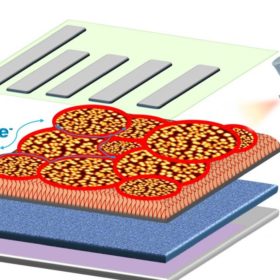
Researchers show world-record 20.9% perovskite cell, new SSG process increasing stability
This marks another world record conversion efficiency for perovskite solar cells. A newly developed process reportedly reduces non-radiative recombination of the cells. The new cell is the result of joint research between the England-based Universities of Oxford, Cambridge, Surrey and China-based Beijing.
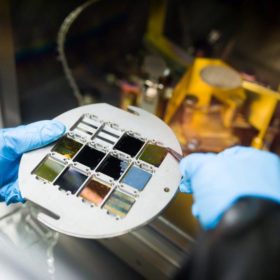
Momentum builds for perovskite tandems, 25%+ efficiency achieved
Researchers from Helmholtz-Zentrum Berlin (HZB) and Oxford PV have presented a new record perovskite tandem solar cell, with a 25.2% conversion efficiency, independently verified by Fraunhofer ISE. Bernd Stannowski, from HZB presented the results this week at the World Conference on Photovoltaic Energy Conversion (WCPEC-7) in Hawaii.
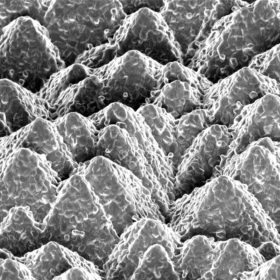
EPFL produces 25.2% silicon-perovskite tandem, ‘cost competitive’ production claimed
Crystalline silicon tandem cell structures show great promise in delivering efficiencies beyond the limits of conventional c-Si. Swiss researchers claim to have gone beyond 25% with a c-Si-perovskite tandem cell structure, using what they claim is a competitive production process.

Skanska, Saule Technologies to install BIPV perovskite modules on office buildings
The two companies have signed a license agreement. The first pilot projects with the semitransparent perovskite solar cells are planned for this year in Poland
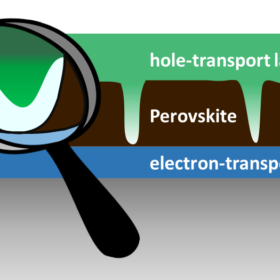
German scientists claim inhomogeneous perovskite films are highly functional
Contrary to common belief, holes in perovskite films may not always negatively affect the performance of perovskite-based solar cells, according to recent research from the Helmholtz Zentrum Berlin (HZB).
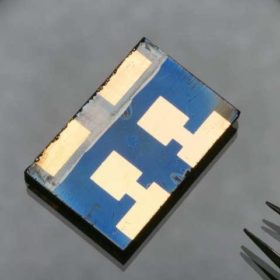
EPFL-led research group seeks to stabilize perovskite solar cells with guanidinium
The group of scientists is adopting organic cations, instead of inorganic cations like cesium or rubidium, to stabilize the crystal structures of perovskites with solar applications.
US scientists use hybrid organic–inorganic perovskites to increase solar cell efficiency
Research funded by the US Department of Energy and conducted by the University of Virginia has demonstrated how the rotation of organic molecules in hybrid organic–inorganic perovskites may expand the lifetime of photoexcited charge carriers.
