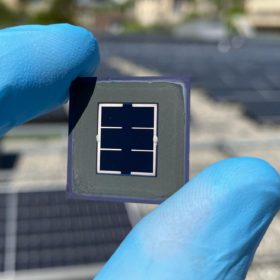
EPFL achieves 29.2% efficiency for tandem solar cell with fully textured silicon
Scientists in Switzerland made significant progress with an approach to perovskite-silicon tandem cell design that they say could eventually be integrated into existing silicon PV manufacturing. They have announced the achievement of a 29.2% cell efficiency – not far from the overall record for tandem cells, and verified by Germany’s Fraunhofer ISE.
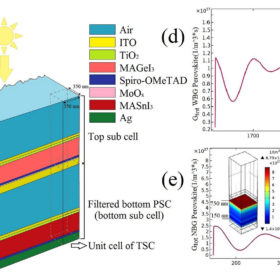
Four-terminal tandem perovskite solar cell design with 30.14% efficiency
The lead-free solar cell was modeled via a three-dimensional finite element method by an Iranian research group. The cell was designed without the buffer layer and with the addition of anti-reflection layer (ARL) strategies, as well as the use of periodic nano-texture patterns.
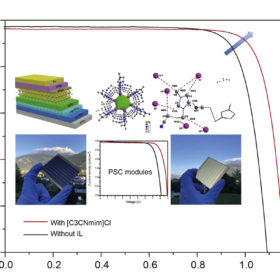
Ionic liquid-based perovskite solar cell with 22.86% efficiency
A Swiss-Japanese research group has used ionic liquids doping to improve the efficiency and stability of perovskite solar cells. Their champion device showed an open-circuit voltage of 1.16 V, a short-circuit current of 24.03 (mA cm−2), and a fill factor of 0.818. It was also able to retain around 95% of its initial efficiency after 1,000 hours of operation.
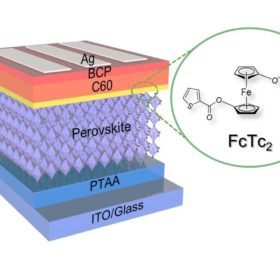
Inverted perovskite solar cell with 25% efficiency
The cell is based on ferrocene and is claimed to retain more than 98% of its initial efficiency after continuously operating at the maximum power point for 1,500 hours under standard illumination conditions.
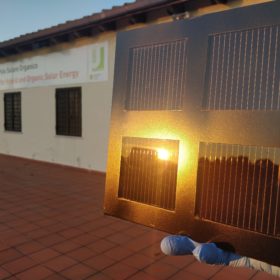
Mini perovskite solar module with 11.9% stabilized efficiency
An international research group has developed a perovskite solar panel on a 192 square-centimeter surface. The researchers claim the panel has one of the highest efficiencies reported at this size to date.
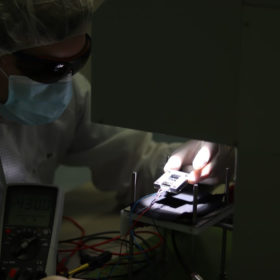
Ultra-thin perovskite-organic tandem solar cell with 24.0% efficiency
Researchers in Germany have built a perovskite-organic solar cell with low interfacial losses and a high open-circuit voltage. The device achieved an open-circuit voltage of 2.15 V, a short-circuit current of 14.0 mA cm−², and a fill factor of 80%.
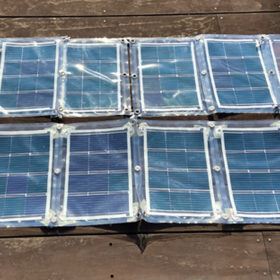
NGK Insulators enters perovskite PV module business
NGK Insulators has invested an undisclosed sum in Enecoat, which develops perovskite solar cells via a wet process based on organic chemistry, a low-temperature coating process, and roll-to-roll printing.

Quantum adjustments for 23.9%-efficient inverted perovskite solar cell
Scientists in Canada fabricated a perovskite solar cell based on an inverted structure that achieved 23.9% efficiency, and maintained 92% of its initial performance after 500 hours of accelerated aging tests. By carefully controlling the thickness of the perovskite layer, the group was also able to gain control of “quantum mechanics” properties such as the movement of electrons within the layer and the wavelengths of light absorbed.

Carbon-based, HTL-free perovskite solar cells with 26% efficiency
An international research team has designed a carbon-based perovskite solar cell without a hole transport layer. Two plasmonic nanoparticles – Ag@SiO2 and SiO2@Ag@SiO2 – were added to the cell photoactive layer, in addition to a copper(I) thiocyanate (CuSCN) interlayer at the perovskite-carbon interface.
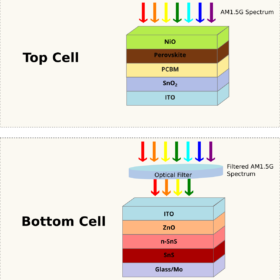
Double-junction perovskite-tin sulfide PV cell design with up to 28.92% efficiency
An Iranian-Italian research group has simulated a double-junction tandem solar cell based on perovskite and tin sulfide. They said that it can reach an efficiency rating of between 22.9% and 28.92%.
