
Perovskite solar cell testing in underwater environments shows surprising efficiency results
Researchers in Italy have tested how perovskite solar cells could perform underwater and have found that, at very shallow depths, they may even achieve a higher power conversion efficiencies compared to reference devices operating under out-of-water conditions.

CNNP Optoelectronics unveils 16.5%-efficient perovskite solar module
CNNP Optoelectronics has started producing a 1,200 mm × 1,600 mm perovskite solar module on a 200 MW pilot line, marking a step toward scaling commercial manufacturing of next-generation PV technologies.

GCL Optoelectronics finishes 1 GW perovskite PV module factory in China
GCL Optoelectronics has commissioned a 1 GW perovskite solar module facility in China, and says it may increase capacity to 2 GW per year depending on market demand.
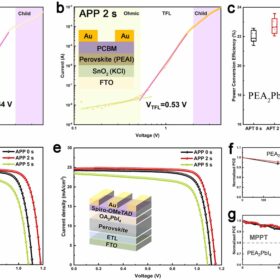
Perovskite solar cell built through Argon plasma treatment achieves 23.55% efficiency
Researchers in China have used an argon plasma polishing pre-treatment (APP) to remove surface defects and increase passivation effectiveness in perovskite solar cells. The result is a perovskite device with a 2D interface that significantly improves stability and performance.
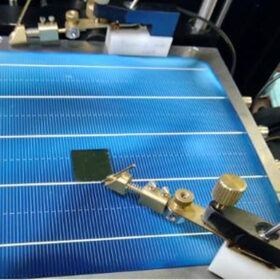
Indian scientists build 29.14%-efficient tandem solar cell with inverted top perovskite device
The researchers said they optimized the low-bandgap inverted perovskite cells through a passivating aluminum oxide (Al2O3) interlayer deposited via atomic layer deposition (ALD), which significantly helped improve device efficiency.

Sekisui, TNO exploring perovskite solar PV collaboration
Japan’s Sekisui Solar Film and the Netherlands’ TNO have signed a letter of intent to explore collaborations related to flexible perovskite solar PV. Talks will be initiated on a potential perovskite module factory in Brabant and the exchange of relevant information.
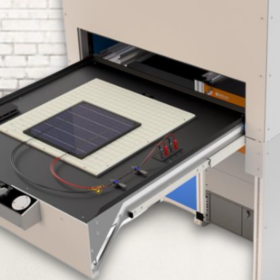
Wavelabs unveils tester for mini perovskite solar modules
The Germany-based testing equipment manufacturer has launched mini-module testing equipment targeted at researchers working on scaling perovskite solar cell technology, thin film devices, and wafer-based PV.
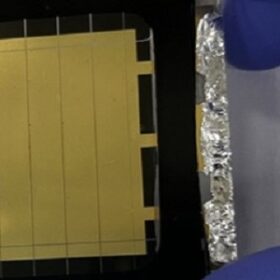
Inverted perovskite solar cell based on ionic salt achieves 26% efficiency
An international team led by the U.S. National Renewable Energy Laboratory (NREL) has used ionic salt for the electron transport layer of a perovskite solar cell to improve device stability and performance. Test results showed a 26% power conversion efficiency with 2% degradation after 2,100 hours of 1-sun operation at 65 C.

Aisin Corporation starts perovskite solar PV outdoor trial
The Japanese automotive components and systems manufacturer began testing its proprietary organic perovskite solar modules in what will be a 30 kW outdoor field trial at one of its facilities in Anjo.
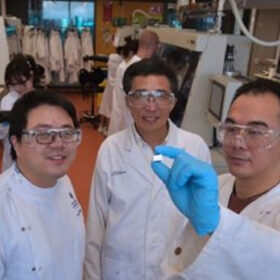
Australian researchers build 2D/3D tin halide perovskite solar cell with 16.65% efficiency
Researchers at the University of Queensland have developed a 2D/3D tin halide perovskite (THP) solar cell with a certified efficiency of 16.65% and peak performance of 17.13%, maintaining stable output under continuous illumination for over 1,500 hours.
