
US launches national security probe into polysilicon imports
The US Department of Commerce (DoC) says it will investigate the potential for export restrictions by foreign countries, as well as their ability to “weaponize” their control over supplies of polysilicon.
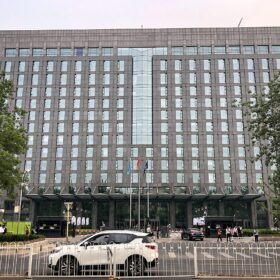
Chinese PV Industry Brief: China Railway awards 3 GW module tender
China Railway Construction Corp.’s IT unit has named 10 preliminary winners for its 2025 solar module framework procurement. The 3 GW contract covers n-type monocrystalline bifacial tunnel oxide passivated contact (TOPCon) modules, with delivery required within 170 days of signing.

China polysilicon price increases amid regulatory signals
In a new weekly update for pv magazine, OPIS, a Dow Jones company, provides a quick look at the main price trends in the global PV industry.

EU expresses reluctance on opex support for solar, cleantech manufacturers
The European Commission has told pv magazine that it will unlikely prioritize operating expenditure (opex) support for solar and clean technology manufacturers, citing concerns about potential market distortion, even as insolvencies rise across the European PV sector.
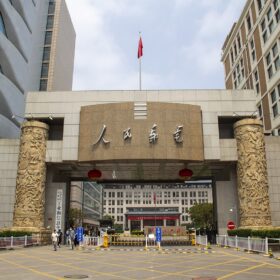
China moves to curb solar overcapacity, stabilize pricing
China’s top industry officials have vowed to curb low-price competition and excess capacity in the solar sector, as authorities begin implementing measures aimed at stabilizing supply chains and rebalancing the market.

Wafer producers scramble to stay afloat despite hydropower advantage
In a new weekly update for pv magazine, OPIS, a Dow Jones company, reports that FOB China wafer prices remained stable this week amid weak demand and low production. It says manufacturers continue to face margin pressure despite seasonal hydropower cost relief and traceability documentation premiums.
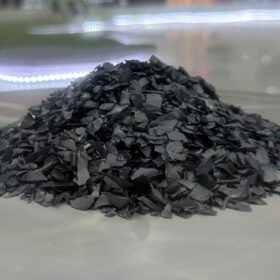
Polysilicon glut may reverse into shortage by 2028, says Bernreuter
China’s polysilicon capacity hit 3.25 million metric tons (MT) in 2024, driving global prices below $4.50/kg, says Bernreuter Research. The Germany-based market analytics firm warns the market could swing to a shortage by 2028 if capacity cuts overshoot.
Chinese PV Industry Brief: More snapshots from SNEC 2025
Solar manufacturers announced a range of module sales agreements, supply deals and new products last week at SNEC 2025 PV Expo in Shanghai.
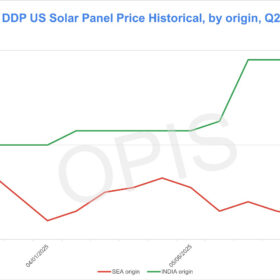
US panel price spread widens between India and Indonesia/Laos origin
In a new weekly update for pv magazine, OPIS, a Dow Jones company, reports that US-assembled modules with imported cells continue to be heard between $0.26/W and $0.33/W, while modules with domestic content – which are still limited to just a handful of producers – are generally quoted between $0.4/W and $0.5/W.
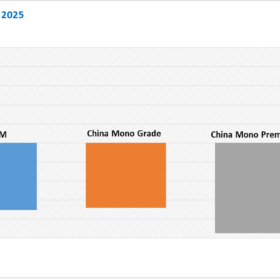
China polysilicon prices fall 11.76% since early April peak
In a new weekly update for pv magazine, OPIS, a Dow Jones company, reports thatglobal polysilicon negotiations remain challenging, as buyers and sellers continue to struggle to reach agreements on pricing amid a persistent supply-demand imbalance. Furthermore, it reveals that China’s polysilicon futures market could imply a further 13% drop for Nov 2025 delivery contracts.
