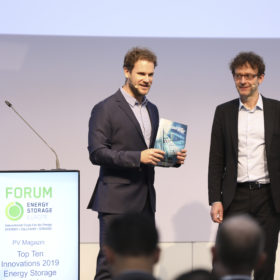
Video: Energy Storage Europe
Energy Storage Europe was held in Düsseldorf from March 12-14. Our editors checked out all the latest technologies at the exhibition. Watch as they review new products and discuss the future of power-to-gas technology.

GW-scale green hydrogen destined for Rotterdam port
The Dutch Institute for Sustainable Process Technology has launched the Gigawatt Elektrolysefabriek project, which aims to produce green hydrogen at the gigawatt scale from wind and solar parks in the Netherlands.
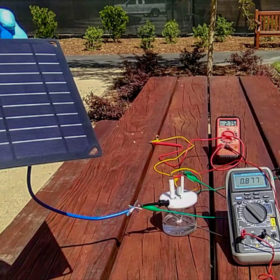
Water, water everywhere, nor any drop to… split?
Researchers at Stanford University have developed a type of electrode which is highly resistant to salt corrosion, therefore allowing them to produce hydrogen using seawater. Applied at a larger scale, this development could potentially cut the cost of power-to-gas applications by greatly increasing the amount of water available.

Hydrogen home storage, refueling hub get financial shot into the arm
Toyota Australia will transform its former manufacturing site in West Melbourne into a renewable energy hub to produce green hydrogen with the help of funding from the Australian Renewable Energy Agency (ARENA). In other hydrogen-related news, researchers at UNSW Sydney with partners H2Store have received a $3.5 million investment from Providence Asset Group to develop a hydrogen residential storage.
Smart electrification 36% cheaper than green hydrogen in Europe
A report commissioned by the European Climate Foundation suggests a fossil fuel-free energy system in Europe by 2050 should largely rely on smart electrification and energy efficiency. Green hydrogen deployment, the report finds, would require prohibitively expensive infrastructure investment.

Medium and small power-to-gas conversion already viable
An international team of economists says power-to-gas may already generate hydrogen at costs competitive with fossil fuel power plants in Germany and Texas, provided certain production output levels are not exceeded. If medium and small power-to-gas is competitive, large-scale should be viable by 2030.
Power-to-gas crucial for solar-based energy system
In the Infrastructure Outlook 2050 study, Gasunie and TenneT say ambitious EU climate targets can only be reached through deeper integration of the power and gas infrastructure, and with power-to-gas technologies supporting renewables. The most bullish scenario for solar states how storage and power-to-hydrogen capacity could be crucial to meet seasonality in supply and demand.
Amprion and OGE announce 100 MW power-to-gas project in Germany
The €150 million project is entering the approval phase. Using the new facility, expected by 2023, the two companies will test how electricity from renewable energy can be converted into green hydrogen and green methane via electrolysis.

The weekend read: From solar to gas
The opportunities for power-to-gas have long interested the solar community, but large-scale projects have been exceptionally rare. The outgoing CEO of SolarPower Europe, James Watson, has presided over a transformative period at the organization, and departed in January to head up Eurogas – right at the point the region’s solar sector is set for revival. Advancing a power-to-gas agenda, Watson tells pv magazine editor in chief Jonathan Gifford, will be a big part of his new challenge.
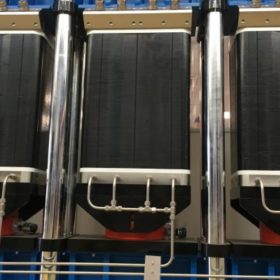
ITM Power plans 100 MW power-to-gas storage project in the UK
The “Project Centurion” will allow the testing of ITM Power’s Proton Exchange Membrane (PEM) electrolyser at Inovy’s Runcorn Site, where hydrogen is being produced as a co-product of the chlor-alkali process.
