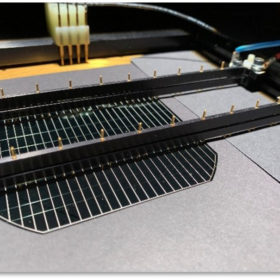
Scaling up perovskite-silicon tandem solar cell performance
Scientists in Germany investigated various routes to optimizing cell design for perovskite-silicon tandem products. Beyond the perovskite layer itself, they note several other areas that should be optimized for tandem cells, taking silicon heterojunction processing as a starting point. The research identifies several routes to cut costs in cell production, including a significant reduction in indium consumption.
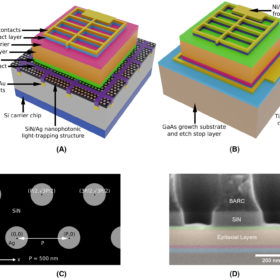
Ultrathin gallium-arsenide solar cell with light management architecture
Scientists led by Cambridge University fabricated an ‘ultrathin’ solar cell, just 80 nanometers thick, using gallium arsenide. The III-V cell achieved 9.08% conversion efficiency, and its developers have demonstrated in simulations that it could reach 16% with further optimization. Given its light weight and intrinsic resistance to radiation, the cell could be suitable to power satellites and other applications in space.
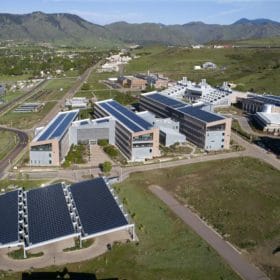
Raising the temperature on module standards
Scientists in the U.S. laid out the rationale behind new PV module testing specifications published last year, which aim to better take into account the role of temperature in various types of performance loss. They suggest a new ‘98th percentile’ approach to measuring module operating temperatures, which would offer system designers a better understanding of the module’s performance in a particular ‘micro-environment’.
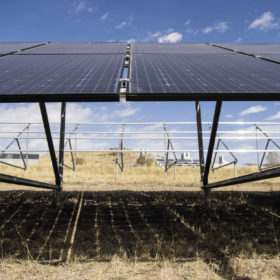
Building on bifacial momentum
Getting the most out of a bifacial module requires a rethink at almost every level of system design and the industry is hungry for field data generated by such systems to better inform energy yield modeling and define the best approaches to maximizing yield at minimal cost. In May, the U.S. National Renewable Energy Laboratory began a three-year study into bifacial performance which is beginning to yield results.
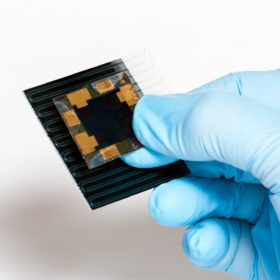
Miasolé sets new flexible CIGS efficiency record
U.S. based Hanergy subsidiary Miasolé has achieved a record 17.44% conversion efficiency for a large area flexible CIGS module. The record has been confirmed by the Fraunhofer Institute for Solar Energy Systems.
