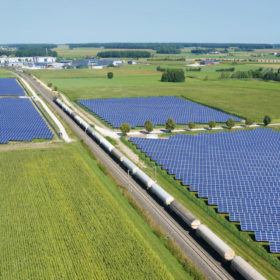
German PV tender brings average solar price of €0.049/kWh
The average price in the October round of Germany’s solar capacity procurement program fell back below the five-cent mark, helped by expansion of the quota for solar on Bavarian agricultural land. Nineteen of the 27 projects allocated by the Federal Network Agency were such schemes.
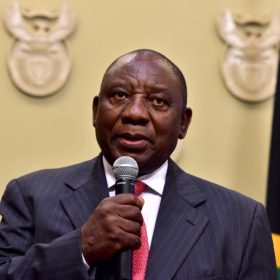
South Africa plans to allocate at least 6 GW of large scale solar by 2030
That would take the country to 8.28 GW of generation capacity by the end of the next decade with the government stating up to 6 GW of small scale capacity could be required on top. By that stage, however, coal would still amount to 43% of generation capacity and gas and diesel a combined 8.1%, under the new Integrated Resource Plan.

PV performance projections for the 21st century
A study has divided the world into 12 climate zones on the basis of the Köppen–Geiger classification map. The paper confirmed Chile’s Atacama region has the world’s highest solar radiation but also showed the region with the highest performance ratio for PV systems was near Moscow.

Average solar power price in Brazilian A-6 auction reaches $20.52/MWh
Only 530 MW of the 2.97 GW of renewable energy generation capacity contracted in the procurement exercise went to solar. Eleven solar projects were successful and their final electricity prices were far below those offered by competing technologies.
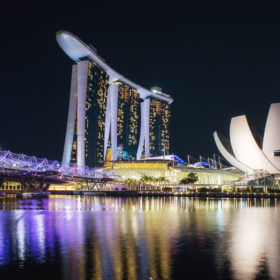
REC kicks off production of new Alpha Series panels in Singapore
With the 600 MW production line the company’s annual module production capacity will approach 2 GW.
Operation Silver Frog: Innovative 2 GW solar production plan for green hydrogen in Europe
European partners have submitted a joint proposal to use EU-made solar modules and wind turbines to power green hydrogen for use by heavy industry. The partners hope to secure designated status and backing from the bloc’s deep coffers.
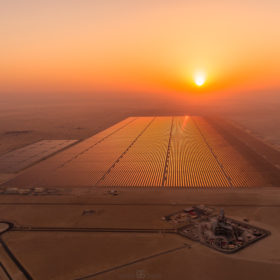
Dubai’s 900 MW solar tender sees lowest bid of $0.0169/kWh
The offer was apparently submitted by Saudi energy giant ACWA Power, which refused to confirm the bid when asked by pv magazine. The second lowest bid – $0.0175/kWh – was reportedly submitted by a consortium formed by Emirati developer Masdar, French utility EDF and Chinese PV panel maker Jinko Power.
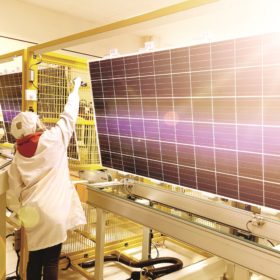
Canadian Solar wins 394 MW of solar in two private auctions in Brazil
After emerging as the recipient of most of the Brazilian government’s public allocation of generation capacity, the Canadian-Chinese manufacturer has secured a large share of projects in auctions held by power companies Copel and, probably, Cemig.
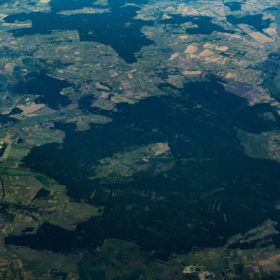
Is solar eroding too much land? The EU thinks not
The EU’s Joint Research Center has created a comprehensive dataset to characterize the solar energy potential in the bloc’s 28 member states. The data shows even a 100-fold increase from current solar capacity would require a very limited amount of land – a lot less than wind power.
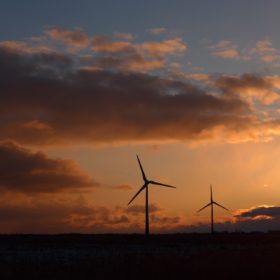
Denmark launches second solar-wind auction
Selected schemes will be eligible for a feed-in premium – related to the wholesale electricity price – for 20 years. The ceiling price for the premium has been set at the equivalent of $0.0089/kWh.
