Features driving efficiency complicate solar cell disassembly, recycling
Researchers in Germany have sought to identify the features that may define the “ideal recyclable solar cell” and have found that the recyclability of PV devices is usually in contrast with the efforts of reaching high efficiencies.
Recycled silicon powder from end-of-life solar panels can be reused in anti-corrosion coating
Researchers in India have demonstrated a wet chemical process to recover silicon with high purity from end-of-life solar panels, which they used to make functionalized silica nanoparticles. Tests of the processed nanoparticles in anti-corrosion coatings showed a corrosion protection efficiency of 99.5 %, which they said was 200 times lower corrosion rate compared to uncoated silica nanoparticles.

New tech to recover high-purity silicon powder from end-of-life solar panels
Korean researchers have used thermal and wet gravity separation (WGS) to separate EVA from reclaimed silicon powder in end-of-life PV modules with “minimal” chemical usage. The proposed technique provides silicon powder that could be reused as a raw material for upcycling into silicon nitride, silicon oxide, or silicon carbide.
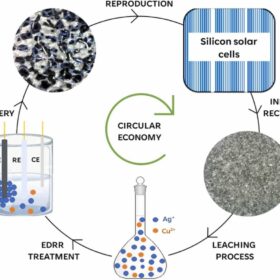
New process to recover silver from end-of-life solar cells achieves 98% efficiency
Scientists have used hydrometallurgical and electrochemical processes to recover pure silver from solar cells. The proposed technique also utilizes a method known as electrodeposition-redox replacement, which reportedly increases the silver recovery rate.
Manufacturers responsible for PV module disposal, confirms EU
The European Council has adopted new amendments to clarify which entities should bear the costs of managing electronic waste, including PV modules.

New research finds Netflix users may consider solar leasing an attractive solution
A group of researchers in Belgium studied the effect of circular business models on residential solar adoption and found a link between Netflix users and consumers open to certain business models.

Indian scientists making high-purity polysilicon ingots from recyled PV cells
Indian scientists have produced high-purity polysilicon ingots from recycled solar cells using “spark plasma sintering” (SPS), and claim they may achieve a purity level comparable to commercially available products.
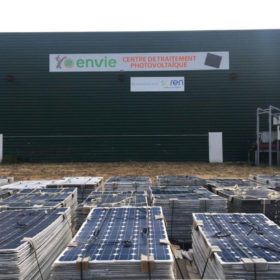
French consortium commissions solar module recycling facility
Soren and Envie 2E Aquitaine have inaugurated a new solar module recycling facility in Saint-Loubès, France.
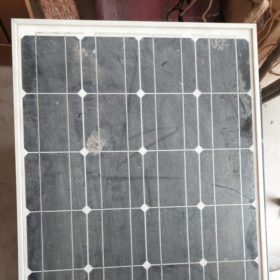
Roadmap for solar module recycling in Bangladesh
Bangladesh currently does not have a recycling center for PV module recycling. But according to a group of local scientists, the country could evolve into a regional hub for PV waste recycling if proper guidelines are implemented.
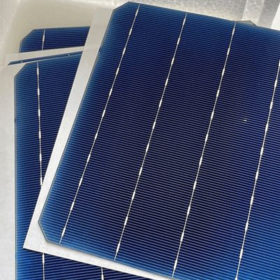
German consortium develops 19.7%-efficient PERC solar cells made of recycled silicon
Led by German research institute Fraunhofer ISE, the consortium has built the solar cells with 100% crystalline silicon recycled from end-of-life photovoltaic panels. The silicon is recycled through a technique conceived by German specialist Reiling GmbH & Co. KG and the Fraunhofer Center for Silicon Photovoltaics CSP.
