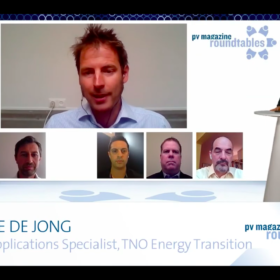
pv magazine video: New tech not without teething pain
pv magazine’s Quality Roundtable this year brought together experts from a broad range of applications relevant in the solar industry. The overarching theme this year was quality concerns with new technologies. Experts from companies and research institutes held that the failures that the industry has observed with technologies such as 2P single-axis trackers are not inherent in the technology but can be addressed.

Value of local manufacturing demonstrated, utilization up but still a long way to go
Indian module manufacturers are gearing up for an end-of-year surge in solar project procurement and hoping their investments in incorporating global manufacturing benchmarks will translate into enhanced sales.

Video: Quality Roundtable tackles glass-glass issue and underground cabling
At The smarter E Europe trade show, held in Munich in May, pv magazine was invited for another iteration of its Quality Roundtable events. Experts from manufacturing, project planning, finance and testing took the stage to inform the crowd on quality issues with modules, cables and inverters.

How cold solder joints turn solar modules into warranty cases
In the run-up to pv magazine’s quality roundtable at Intersolar Europe, we look at a case where a production error resulted in cold solder joints in 5% of the solar modules across a 50 MW project portfolio. We consider how to come to an agreement with a manufacturer to replace modules in such a situation and how such a solution compares with a production audit before installation.
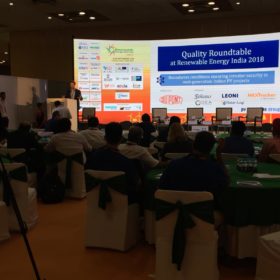
Video: Quality Roundtable REI 2018
pv magazine’s Quality Roundtable at this year’s Renewable Energy Expo India (REI), attracted analysts and experts from across the industry, who gathered in Greater Noida to discuss the challenges and opportunities present in the massive Indian solar market.
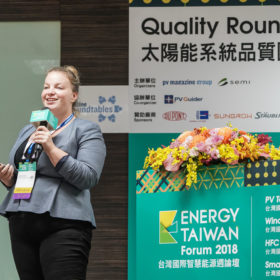
Video: Quality Roundtable Energy Taiwan 2018
LID mitigation in mono-PERC cells is technically feasible, according to Jay Lin and Karin Krauß, who spoke during pv magazine’s Quality Roundtable in Taiwan. The country’s rapidly growing floating PV market was also addressed.
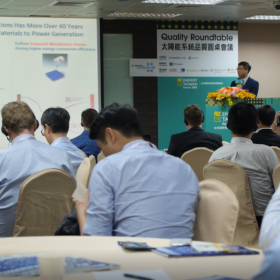
pv magazine Quality Roundtable, Taiwan: Carrier-induced solar cell degradation: Solved (sort of)
Solar cell manufacturers are always on an R&D race to improve efficiency. But even with their efforts, today you can still expect up to about a 3.5% loss from carrier- or light-induced degradation, industry insiders claimed last Thursday at pv magazine’s Quality Roundtable, held at Energy Taiwan 2018 in Taipei.

Challenges and solutions for anti-LID treatment
In PERC modules, both light and elevated temperature induced degradation (LeTID) and light induced degradation (LID) must be mitigated. What makes this tricky, however, is that the mitigation process of the first, counteracts that of the second, says Karin Krauß, R&D project manager, Rehm Thermal Systems. At the pv magazine Roundtable in Taipei next week, she will discuss possible solutions with cell and module manufacturers, and EPCs.
Ensuring quality will bring “reputation, prestige” to Indian PV
“Profitable yet risky”: This was one of the findings of a recent study, released in July, conducted by PI Berlin on behalf of Germany’s National Metrology Institute (PTB) when examining six Indian PV projects from the viewpoint of project quality. The report’s author Asier Ukar spoke to pv magazine in advance of his presentation on the subject at the Quality Roundtable at the Renewable Energy India conference next week.

9th PV Quality Roundtable: Stopping the blame game
At pv magazine’s 9th Quality Roundtable, held last month in Germany, a host of experts debated pressing quality issues, from LID in PERC modules, to hailstorm damage and faulty backsheets. In a video interview, Stephan Padlewski of DuPont goes into more detail about the quality debate, and how it has developed over the past years. He also discusses DuPont’s testing regime.
