
New tool for PV plant design on terrains with complex orography
Spanish engineering company Sener has developed a software that analyzes different combinations of panels, trackers or tables, inverters and storage systems, as well as construction costs, depending on the market situation at any given time and the client’s preferences.

The Hydrogen Stream: Metal foam for low-cost green hydrogen generation
Researchers from Saudi Arabia’s King Abdullah University of Science and Technology have presented the results of a low-cost method of generating carbon-free hydrogen. In other news, Norwegian fuel cell producer Nel ASA said it was ready to increase its electrolyzer production capacity to meet the European Union’s raised ambitions for renewable hydrogen, while oil giant Petronas Eneos announced plans to set up a hydrogen production plant in Indonesia.
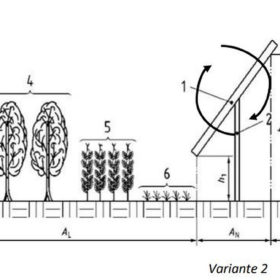
Italian solar sector defines standards for agrivoltaics
A document compiled by three Italian renewables associations identifies with extreme precision the area that is allowed to be used for power generation in the two most common agrivoltaics configurations — solar arrays with elevated solar modules and PV systems deployed between crop rows.

Russian invasion of Ukraine weighing on Moldova’s PV sector
The first months of the year pointed to a boom in Moldova’s solar sector, but the war has already started to negatively affect investment decisions.
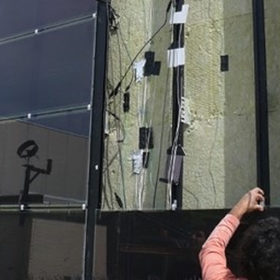
Photovoltaic forced ventilated facade for applications with air source heat pumps
Scientists in Spain have designed a BIPV forced ventilated facade that can be used as support for heating and a domestic hot water (DHW) building system based on air source heat pumps (ASHPs). In the proposed system configuration, the heat pump is expected to cover building heating demand at all times, regardless of the performance of the solar array.
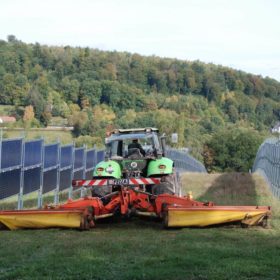
Solar-plus-food in ethanol fields could fully power the United States
The conversion of the 40 million acres of ethanol corn farms in the United States into solar-plus-food facilities could generate 1.5 times the nation’s electricity needs, while also powering a 100% electrified passenger vehicle fleet.
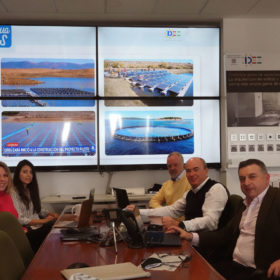
Solar desalination via floating PV in Spain
The Agua+S project under development in the Spanish region of Andalucia is aimed at combining a desalination plant, a pumping station network, and an onshore, floating photovoltaic plant in a single project design. According to its developers this is the first time that these three facilities have been combined together in a fully reproducible design that could be replicated in any river basin that has a reservoir and is close to the coast, to produce fresh water for both irrigation and human consumption.
France’s tender for utility scale solar concludes with final average price of $0.06499/kWh
The procurement exercise’s final average price is 7% higher than that of the previous tender of the same kind. Around 704.9MW of PV capacity was allocated by the French authorities.
Sonnedix acquires Polish solar developer Sun Power Energy
The Polish company has a PV project pipeline of over 1GW.
Huawei, Meinergy plan 1GW/500MWh solar-storage project in Ghana
Huawei and Meinergy plan to build a facility that could end up being Africa’s largest solar-plus-storage project. Huawei will supply its storage tech for the installation.
