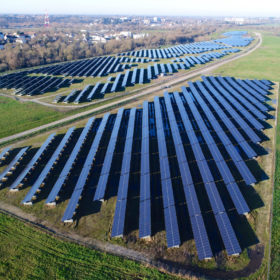
Tech advances halving surface needed for ground-mount solar
French developer VSN Energies Nouvelles was able to almost double the capacity of one of its PV projects due to technological advances such as high-powered panels and new plant design concepts.
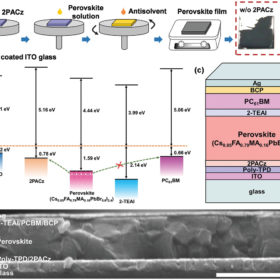
Inverted perovskite solar cell with 21.85% efficiency via surface modulator
A UK research group has used surface modulators to reduce non-radiative recombination in perovskite solar cells. They used 2-TEAI organic halide salt to build a cell with high power conversion efficiency and stability.
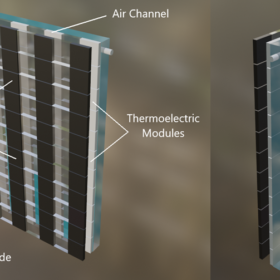
PV-powered thermoelectric cooling for air conditioning in buildings
Scientists have proposed a way to combine thermoelectric modules (TEMs) with rooftop PV to support heating, ventilation and air conditioning in buildings. They designed a wall-integrated TEM to heat and cool adjacent rooms.
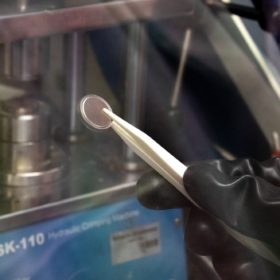
New polymer-based battery electrodes with high stability
UK researchers have developed organic electrode materials to integrate redox-active organic molecules into long-chain polymers. The new electrodes exhibit better cycling performance in lithium-ion batteries, with no apparent capacity decay over more than a thousand charge-discharge cycles.

Indonesia may add 66 GW of solar by 2030, says IRENA
The International Renewable Energy Agency (IRENA) says that solar could become the backbone of Indonesia’s energy system by 2030. However, the nation’s own expectations are still far off from IRENA’s scenarios.
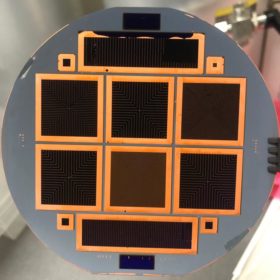
Silicon heterojunction solar cell with 23.83% efficiency via molybdenum oxide hole collector
Dutch scientists have achieved a record-breaking efficiency for a silicon heterojunction solar cell fabricated with a hole collector based on a molybdenum oxide (MoOx). They used plasma treatments to increase the presence of oxygen in the MoOx layer, to improve its electronic properties.

Uninterrupted PV generation without storage
An Israeli scientist has proposed a way to achieve uninterrupted PV power on the moon without using energy storage. The proposal involves the installation of PV panels around a 360-degree latitudinal ring close to one of the moon’s poles. There would be no inter-array shading, and static vertical PV arrays and arrays mounted on single-axis vertical trackers could be viable mounting structures.
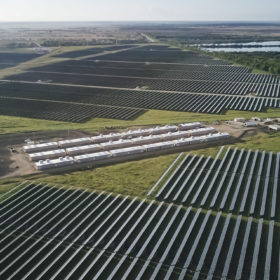
Operations begin at 87 MW solar-powered bitcoin-mining center
Aspen Creek Digital, a US bitcoin miner, has started operations at a 30 MW bitcoin data center powered by an 87 MW solar park in Texas. The project is the company’s second solar-powered bitcoin-mining center.

Spain, Portugal to lead renewables in Europe, says Rystad
Norwegian consulting firm Rystad Energy has described the Iberian Peninsula as “a new European energy powerhouse.” It expects Spain and Portugal to reach 79% renewables in their combined electricity mix by 2030.

Thailand introduces FIT scheme for solar, storage
In an unexpected move, the government of Thailand has introduced a feed-in-tariff (FIT) of THB 2,1679 ($0.057)/kWh over 25 years for solar and a 25-year FIT of THB 2,8331/kWh for solar plus storage.
