
Hoarfrost-inspired technique to improve MPPT in PV systems under partial shading
Scientists in China have introduced developments to the RIME optimization method, which takes inspiration from the developmental course of hoarfrost in nature. They have compared it to other MPPT algorithms and found it to be faster and to improve power output.
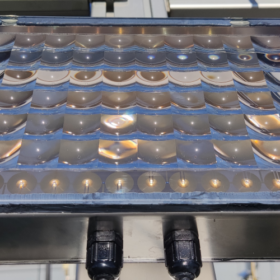
Fraunhofer ISE unveils micro-CPV module with cost-reducing design
Researchers in Germany have unveiled new high-efficiency, micro concentrator photovoltaics technology that taps established micro-components manufacturing processes to enable lower costs. A demonstrator relying on the micro-CPV module achieved efficiency of 36% based on IEC62670-3 concentrator standard test conditions.
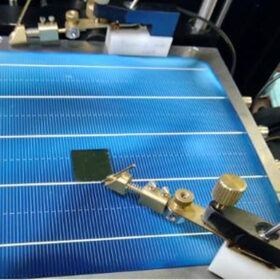
Indian scientists build 29.14%-efficient tandem solar cell with inverted top perovskite device
The researchers said they optimized the low-bandgap inverted perovskite cells through a passivating aluminum oxide (Al2O3) interlayer deposited via atomic layer deposition (ALD), which significantly helped improve device efficiency.
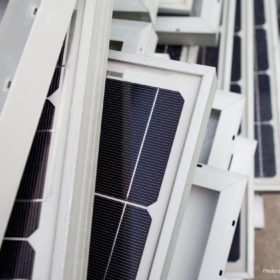
European initiative launches digital product passport prototype for PV
A digital product passport could support circular practices in the European PV industry by better tracking material composition, recyclability, and supplier information, crucial for material recovery.

Perovskite-silicon tandem solar cell built with hybrid blade coating achieves 27.8% efficiency
The King Abdullah University of Science and Technology and the Fraunhofer Institute for Solar Energy Systems report producing perovskite-silicon tandem solar cells with open-circuit voltages exceeding 1.9 V as the result of a two-step hybrid evaporated/blade-coated process for perovskite films.

Deploying floating PV on mine pit lakes, tailings ponds
Researchers in South Korea have conducted a literature review on recorded cases of floating PV plants placed on mine pit lakes and tailings ponds, both of which are byproducts of the mining industry. Looking at more than dozens of cases, they have concluded that mine pit lakes generally provide more stable environments for deployment.

GCL achieves 29.51% efficiency for perovskite-silicon tandem module
GCL Optoelectronics has achieved 29.51% efficiency for its perovskite-silicon tandem solar module, with the result certified by China’s National Institute of Metrology.
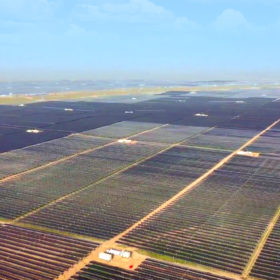
Hybrid deep learning model for PV forecasting in scenarios with considerable fluctuations
Researchers in China conceived a new PV forecasting approach that integrates causal convolution, recurrent structures, attention mechanisms, and the Kolmogorov–Arnold Network (KAN). Experimental results demonstrate that the proposed model outperforms 10 existing forecasting models.
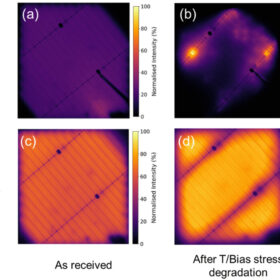
Scientists discover new failure mode in LECO-treated TOPCon solar cells
An international research team has observed a significant increase in series resistance in LECO-treated TOPCon solar cells after temperature and bias treatment. The scientists said they now need to conduct further investigations into its impact on cell efficiency, reliability, and bankability.
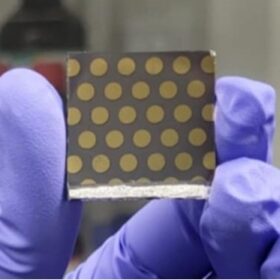
U.S. scientists build antimony sulfide solar cell with 7.69% efficiency
Researchers at University of Toledo produced antimony sulfide (Sb2S3) thin film solar cells with 7.69% power conversion efficiency after determining optimal hydrothermal deposition, post annealing, and light soaking conditions. Stability tests showed more than 95% of initial efficiency after ten months.
