
Low-cost direct solar-to-hydrogen ambitions see the light
The road to cheap hydrogen production is riddled with potholes and energy losses. Researchers in Australia have demonstrated rethinking solar technology and skipping electrolysers could hold great promise for reaching the hydrogen holy grail.
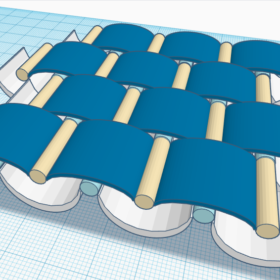
Parabolic bifacial module with active cooling system
Scientists in Morocco have designed a new bifacial module with a cooling system, based on bifacial parabolic solar cells that are connected to each other via tubes for panel cooling. They are now patenting the tech, but have yet to manufacture an initial prototype.
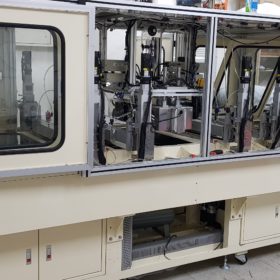
New production equipment for large-area perovskite solar cells
National Taiwan University and Taiwanese PV production equipment provider E-Sun Precision Industrial Co. have developed equipment to produce different kinds of perovskite cells with varying chemical compositions. The first trials achieved 14.3% conversion efficiency rates.
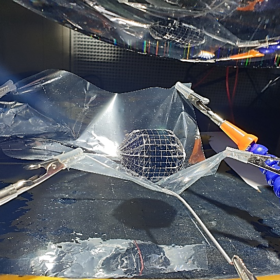
Spherical monocrystalline solar cells with 18.93% efficiency
The spherical 3D cells can reportedly generate around 101% more power than conventional flat solar cells. Measurements have also shown that the spherical cells provide a 10% lower maximum temperature compared to flat cells, while accumulating less dust.

Deploying rotating PV arrays on cooling towers
Swedish researchers have proposed the installation of rotating and revolving PV arrays on the cooling towers of thermal power plants. While such projects are ideal in nations with limited land, installation costs are also cheaper than for ground-mounted or rooftop PV plants due to proximity to the grid, the scientists claim.

Mobile solar pumping system offers pay-as-you-go solution for Indian farmers
Researchers have simulated a cart-mounted solar pump which they say would mean farmers in off-grid areas would be able to irrigate fields by paying only for the solar electricity used.
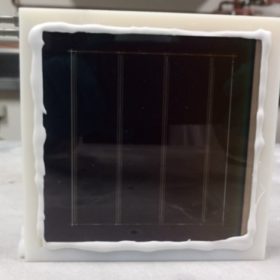
PV-electrochemical water-splitting for hydrogen production
A German research team has developed a new photovoltaic-electrochemical device for alkaline water electrolysis. The prototype has an initial solar‐to‐hydrogen efficiency of approximately 7.7%.

A look at China’s PV poverty alleviation policy
A global research team says that China’s PV poverty alleviation scheme has ramped up disposable income levels in the country’s poorest counties. The Chinese government aims to install more than 10 GW of PV, especially in the most impoverished parts of eastern China, to help 2 million people by the end of this year.

Hydrogen storage in salt caverns
Researchers in Germany have identified salt caverns as a feasible and flexible solution for hydrogen storage. They also revealed that Europe has the potential to inject hydrogen in bedded salt deposits and salt domes, with a total storage capacity of 84.8 PWh.

CIGS solar cell with IBC structure and up to 19.7% efficiency
Scientists in the Netherlands have demonstrated an interdigitated back contact copper-indium-gallium-selenide solar cell with a sub-micron thickness of 673nm. The device has an aluminum oxide and magnesium fluoride-based anti-reflective coating.
