
Trump budget guts solar research at NREL and Berkeley (14 essential documents embedded)
The president’s federal budget for Fiscal Year 2018 includes the expected cuts to renewable energy within the DOE’s walls, but the cuts to prominent national labs – including the elimination of energy-storage research funding at both – could have unforeseen long-term effects on the industry.
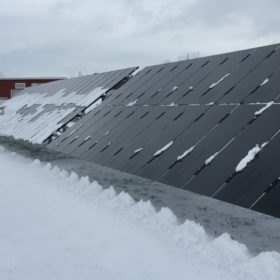
U.S.-Turkish research team uses data science to predict PET back-sheets degradation in solar modules
The scientists have used engineering epidemiology and statistical-data analytics to predict how polyethylene terephthalate films in solar panels deteriorate under multi-factor accelerated weathering exposures.
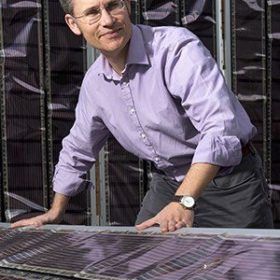
Uni Newcastle team tests “printed solar” panels in Australian first
Just days after Tesla announced it was taking orders – and down-payments – for its much-hyped and quite good looking solar roof, an Australian made printed solar innovation that could rival Elon Musk’s power generating tiles has moved one major step closer to commercialisation.
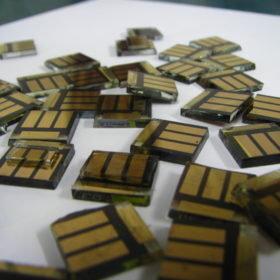
Atomic scale design could pave the way to more persistent solar cells, study says
Researchers from ICL claim to have discovered the cause for the rapid decrease in performance of perovskites. Adding iodide ions may help improve the stability of solar cells.

University of Twente publishes research on back reflector materials
Researchers at the Netherlands’ University of Twente have developed a material comprising thin, diamond-like photonic nanostructures which reflect a surprisingly wide range of colours of light, from all angles. This could make the material ideally suited for use as a back reflector for PV modules.
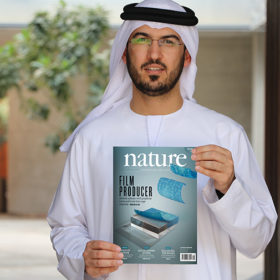
Masdar & MIT develop method for high efficiency semiconductor materials
Researchers from the Abu Dhabi based Masdar Institute and the renowned Massachusetts Institute of Technology have jointly published the development of a fabrication method, which they say could make high efficiency semiconductor materials such as gallium-arsenide, indium phosphide and others more competitive with crystalline silicon.
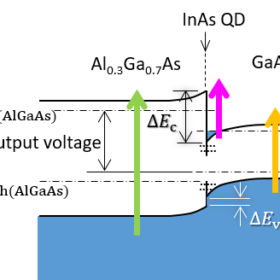
Japanese scientists seek to develop solar cell able to absorb spectral components of longer wavelengths
The new technology is designed to capture the spectral components of longer wavelengths that are usually lost during transmission through the solar cell. The Japanese scientists are using up-conversion of below-gap photons to reduce power losses and increase the cell efficiency.
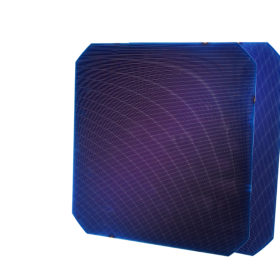
Imec claims 22.8% efficiency for bifacial n-type PERT solar cell
The Belgian research institute has developed a bifacial n-PERT solar cell with a conversion efficiency of 22.8%. Imec researchers claim this cell has the potential for a cost-of-ownership at module level of less than $0.30/W.
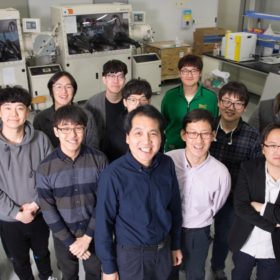
Korean University team develops 21.2% efficient perovskite solar cell
Researchers at the Ulsan Institute of Science and Technology (UNIST) in South Korea have announced the development of a method to produce perovskite solar cells, which the University says could contribute to commercialization of the technology.

“Skinny Budget” nukes U.S. renewable energy research
President Trump’s Department of Energy hit list includes advanced energy research, loan guarantees and the Office of Energy Efficiency and Renewable Energy.
