
The Hydrogen Stream: Global electrolyzer market to reach 8.5 GW by 2026
GlobalData has predicted that the global electrolyzer market will hit 8.52 GW by 2026. BP and Thyssenkrupp have agreed to cooperate on the use of hydrogen in the steel sector, while electrolyzer supplier Nel Hydrogen has secured orders in Australia and Denmark.
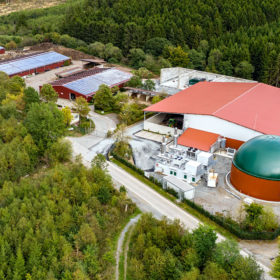
Photovoltaics and anaerobic digestion
Researchers in Egypt have studied the use of solar power and anaerobic digestion for a 6,300-square-meter farm capable of housing 200 head of milk/beef cattle. They found that this combination could achieve a cost of energy of $0.0226/kWh.
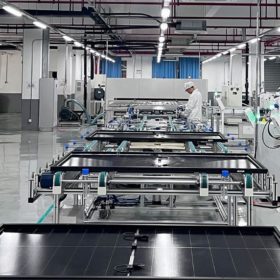
Chinese manufacturer unveils 210 mm busbarless heterojunction solar module
China’s Cando-solar Photoelectric Technology said its newest solar panel has a power output of up to 425 W and a power conversion efficiency of up to 22.1%. Its temperature coefficient is -0.24% per degree Celsius.
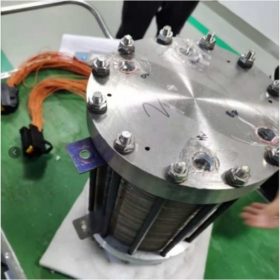
PEM electrolysis coupled with thermal energy storage
Chinese researchers claim to have improved the performance of a proton exchange membrane electrolyzer by connecting it to a thermal energy storage system.
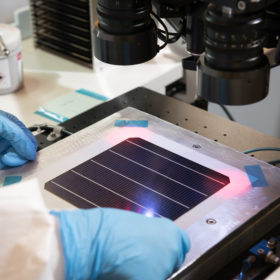
Environmental impacts of perovskite PV
A life-cycle analysis of perovskite-silicon tandem modules indicates that additional environmental impacts in manufacturing are more than offset by the higher energy yield over their lifetime.
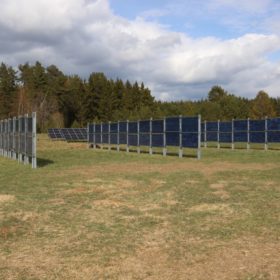
The stabilizing effect of vertical east-west oriented PV systems
German researchers have looked at how vertical PV systems could provide more electricity during periods of higher demand, while enabling a higher level of integration with agricultural activities.

Smart solar window based on thermochromic laminate
Dutch researchers have developed a solar window concept that blocks heat from the sun in warm weather and absorbs heat during colder periods.
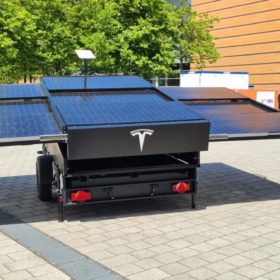
Tesla’s solar trailer for range extension
Tesla has unveiled a fold-out solar trailer equipped with nine panels and a SpaceX Starlink satellite internet system.

CSEM, EPFL achieve 31.25% efficiency for tandem perovskite-silicon solar cell
The new world record was independently certified by the National Renewable Energy Laboratory (NREL) in the United States.
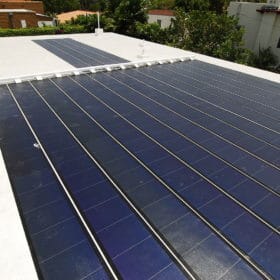
Thin film solar may have carbon intensity advantage over silicon
Thin-film cadmium telluride panels may have a $0.02 to $0.04 per watt carbon cost advantage over traditional polysilicon, said the National Renewable Energy Laboratory in an analysis of embodied carbon, embodied energy, and energy payback.
