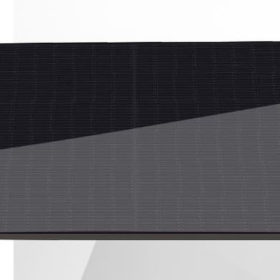
DMEGC launches M10 rooftop solar modules with 410 W of output
China’s DMEGC has released new solar panels with power conversion efficiencies of up to 21.2% and temperature coefficients of -0.33% per degree Celsius. They can be used with maximum system voltages of 1,000 V or 1,500 V.
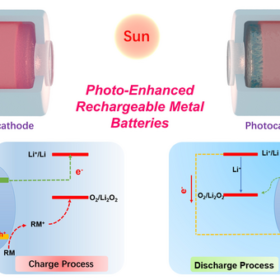
Photon-enhanched rechargeable batteries for solar storage
Japanese scientists have analyzed storage systems that combine PV and high-energy-density metal batteries. The rechargeable batteries have advantages such as low-charge voltage and high energy density, but stability and safety must be addressed before they reach commercial maturity.
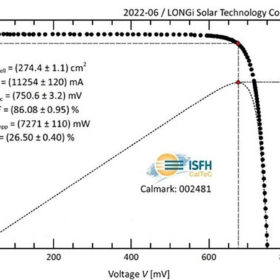
Longi’s heterojunction solar cell hits 26.5%
Germany’s Institute for Solar Energy Research Hamelin has confirmed that Longi’s new n-type heterojunction solar cell has achieved a power conversion efficiency of 26.5%.
RETC releases 2022 Module Index Report
The Renewable Energy Test Center has released a new report on PV module performance.
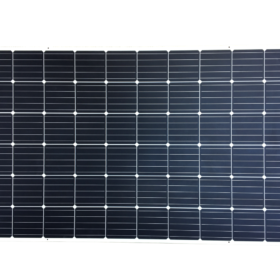
Solar module for lightweight applications from France
French manufacturer 2CA has developed a 20%-efficient solar module that weighs four times less than a glass-glass module of the same size. It claims the frameless, self-supporting panel could be used for lightweight applications at military camps and other remote locations.
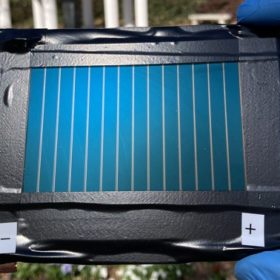
Automatically generated databases for perovskite, dye-sensitized solar cells
University of Cambridge scientists have created new databases for dye-sensitized and perovskite cells, respectively. They used the ChemDataExtractor text-mining toolkit to collect the data.
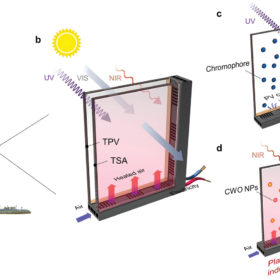
Solar window generates electricity, thermal energy
A research team in Hong Kong has built a solar window that can generate power on the external side via a luminescent solar concentrator and thermal energy on the internal side via transparent solar absorbers.
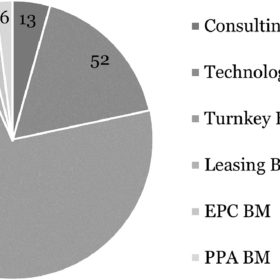
Business models for Swedish solar
Swedish researchers have identified six business models for the country’s solar market and highlighted how companies differ significantly in their approaches from policymakers and scientists. They analyzed data from 241 solar companies.
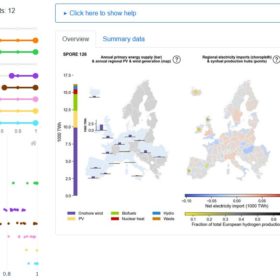
Open-source online platform shows how Europe may become energy-independent with renewables by 2050
European researchers have developed an open-source online tool that can identify areas where renewable energy and synthetic fuels can be cost-effectively produced, where hydrogen hubs could be built, and where grid expansion is needed. It can be used in different sectors across 35 countries.
Australian companies vying for $3.1 billion green hydrogen project in New Zealand
Fortescue Future Industries and Woodside have been selected as the two finalists in the race to develop what could be one of the world’s largest green hydrogen projects – a 600 MW facility in New Zealand.
