All solar cell efficiencies at a glance
The research group led by Professor Martin Green has published Version 58 of the Solar cell efficiency tables. He spoke with pv magazine about the criteria with which these tables are compiled and the importance of result certification by independent third parties.
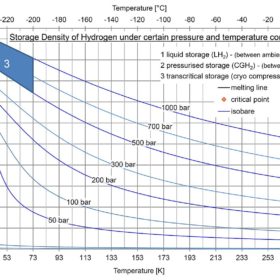
New tool to evaluate economic benefits of hydrogen storage
Developed by U.S. scientists, the Hydrogen Energy Storage Evaluation Tool (HESET) can assess the economic and technical characteristics of individual system components and the modeling of each hydrogen pathway. Furthermore, it can help understand how hydrogen storage can be used for various grid and end-user services.
Storage solution takes batteries back to basics
Urban Electric Power has been accepted into EPRI’s Incubatenergy Labs program to prove the value of its new battery tech to some of the top utilities in the United States.

New cathode design promises battery sustainability
Scientists in the U.S. developed a new cathode design for lithium-ion batteries that they say could open up a range of different materials for further research. The group has high hopes that the discovery can quickly be brought to scale, easing some of the growing concerns around supply chains for battery materials.

Proper recycling could help perovskite modules to outcompete rivals
Proper recycling strategies for perovskite modules could ensure sustainability and improve energy payback times, according to US researchers. They claim that the best recycled perovskite cell architecture could produce an energy payback time of about one month, versus 1.3 to 2.4 years for crystalline silicon modules.
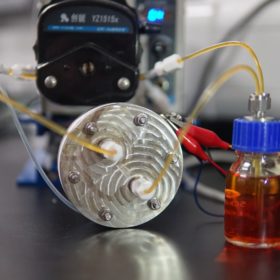
Sulphur-based redox flow battery with 15 consecutive hours of runtime
Researchers from Hong Kong have applied a novel charge-reinforced, ion-selective (CRIS) membrane to a polysulfide-iodide redox flow battery they had built in 2016. The redox flow battery showed a capacity decay rate of just 0.005% per day for 1,200 cycles, and a lifetime with over 2,000 hours’ cycling, which the academics said corresponds to approximately three months.

Nanoparticles enable completely clear, industry-sized solar windows
Australian company ClearVue Technologies says it has a fully transparent, scalable, industry-ready solar window in production. It claims that it’s now just 18 months away from cracking 5% efficiency, thanks to a research partnership.

The Hydrogen Stream: 45 GW project in Kazakhstan, new push from Norway
German project developer Svevind Energy and Kazakh Invest wants to build a 45 GW green hydrogen complex in Kazakhstan. Norwegian companies Equinor, Aker Group and Saga Pure announced separate plans to further develop their green hydrogen solution.

Fraunhofer ISE unveils 68.9%-efficient III-V solar cell for laser energy transmission systems
The German research institute said the gallium arsenide cell has achieved the highest efficiency to date for the conversion of light into electricity.

Using the oceans’ depths to store renewables, compress hydrogen
Underwater gravity energy storage has been proposed as an ideal solution for weekly energy storage, by an international group of scientists. The novel technology is considered an alternative to pumped-hydro storage for coasts and islands without mountains that are located close to deep waters, and may also be interesting for PV if used to store green hydrogen.
