
Japanese scientists build all-perovskite tandem solar cell with 30.2% efficiency
The four-terminal tandem device relies on FAPbI₃ nanoparticles and a spectral splitting design, combining a 24.4% wide-bandgap top cell and a 21.5% narrow-bandgap bottom cell to reach 30.2% efficiency. The system improves light utilization by directing different wavelengths to optimized subcells.
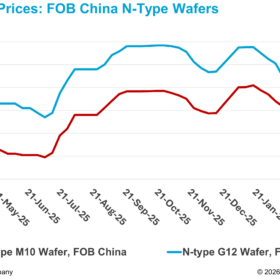
China wafer declines narrow as demand-side regulation lifts market sentiment
In a new weekly update for pv magazine, OPIS, a Dow Jones company, provides a quick look at the main price trends in the global PV industry.
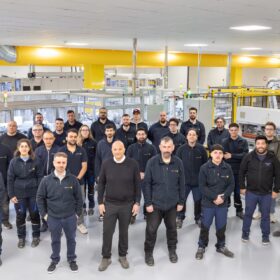
Inside PV Manufacturing: Midsummer’s CIGS factory in Italy
The Swedish thin-film solar specialist produces 50 MW of modules at its Bari facility, using its proprietary DUO system for cell manufacturing. The company says it sources all materials from the EU and other countries in the global North.
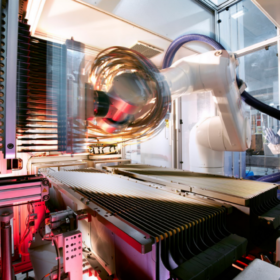
Trina Solar, JA Solar, JinkoSolar launch China’s first PV patent pool for TOPCon technologies
China’s solar industry has launched its first TOPCon-focused patent pool, led by Trina Solar, JA Solar, and JinkoSolar, to streamline licensing, reduce disputes, and strengthen IP coordination at home and abroad.

Rethinking silver paste design for TOPCon, LECO solar cells
Researchers in China have developed an evaluation framework to better assess fine-line silver pastes for TOPCon and LECO solar cells. The approach links laboratory characterization directly with production-line performance, addressing the limitations of conventional evaluation methods.

Fabricating perovskite solar cells with robotic boxes
An international research team has developed an AI-driven robotic platform that autonomously designs, fabricates, and optimizes perovskite solar cells, completing the full experimental workflow in a closed-loop system. Using the platform, the researchers fabricated and tested more than 50,000 devices, achieving efficiencies of up to 27%.

Will we finally buy European PV modules?
In a new monthly column for pv magazine, the Becquerel Institute explains why Europe’s solar manufacturing outlook is shifting from decline to cautious opportunity, driven by rising energy uncertainty and new regulations like the Net-Zero Industry Act that create fragmented, nationally defined markets with partial protection for domestic producers. While demand and policy support are strong, complexity, uneven implementation, and competition risks mean success will depend on how quickly and strategically industry players navigate this narrow window.

Trina Solar TOPCon patents invalidated in US ruling involving Canadian Solar
The U.S. Patent and Trademark Office has invalidated all claims of two TOPCon solar cell patents previously asserted by Trina Solar against Canadian Solar subsidiaries.
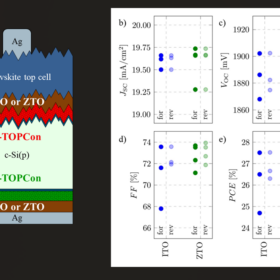
Perovskite–silicon tandem solar cells using zinc-doped tin oxide achieve comparable performance to indium tin oxide counterparts
Fraunhofer ISE-led researchers demonstrated zinc-doped tin oxide (ZTO) as an indium-free alternative to indium tin oxide (ITO) for recombination layers in fully textured perovskite–silicon tandem solar cells. ZTO delivers comparable device efficiencies of 27–28% under current-matching conditions, offering a scalable, indium-free pathway for high-performance tandem photovoltaics without efficiency loss.
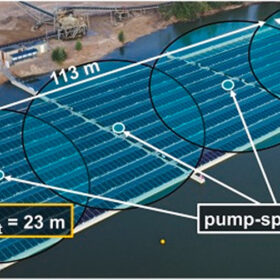
Spray cooling for floating PV
A research team in Germany developed a dynamic model of spray cooling for floating PV systems that couples thermal behavior, electrical performance, and active cooling, and validated it against a 750 kW installation. Simulations across four climates showed that spray cooling reduces module temperatures by up to 42% and improves energy yield by up to 3.8%, with benefits strongly dependent on local conditions.
