
Antimony vs. phosphorous doping in solar wafer manufacturing
An international research team comprising scientists from Chinese module manufacturer Longi has investigated the resistivity distribution of antimony- and phosphorous-doped wafers used in solar cell manufacturing and have found that they offer comparable mechanical strenght. However, their work also showed that antimony-doped wafers have a more uniform resistivity, with a slight increase near the tail end.

Building the perfect perovskite, one layer at a time
A University of Cambridge-led team of researchers have demonstrated precisely controlled layer-by-layer epitaxial vapor growth of two-dimensional halide perovskite films in an industrially compatible process. Their findings could help develop more thermally stable perovskite solar cells.

U.S. extends solar manufacturing tariff exclusions
The U.S. Trade Representative has extended the exclusion of 178 items from the Section 301 import tariffs that were put in place by the prior administration in 2024. The still standing tariffs include a 50% increase on solar cells.

JinkoSolar achieves 34.76% efficiency for perovskite-silicon tandem solar cell
JinkoSolar says it has increased the efficiency rating for its perovskite-silicon tandem solar cells from 34.22% to 34.76%, confirmed by China’s National PV Metric & Testing Center (NPVM).
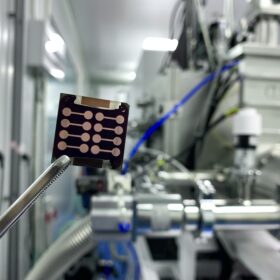
All-perovskite tandem solar cell with dipolar passivation achieves 30.1% efficiency
Researchers in China have developed a dipolar passivation method that reduces defects and improves charge transport in solar cells based on narrow-bandgap tin lead perovskite. The approach has enabled the fabrication of all-perovskite tandem solar cells with efficiencies of around 30% and enhanced stability,

N-type wafer prices extend four-week slide amid weak demand, rising inventory concerns
In a new weekly update for pv magazine, OPIS, a Dow Jones company, provides a quick look at the main price trends in the global PV industry.
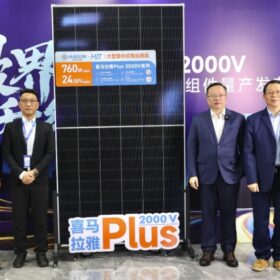
Huasun unveils 770 W, 2,000 V heterojunction solar module
The Chinese manufacturer said the higher-voltage design of the new module reduces cable, combiner, pile-foundation, and land-use requirements, delivering balance-of-system savings of up to CNY 0.15 ($0.012)/W in western China. The module offers a power output of 730 W to 770 W and a conversion efficiency of up to 24.8%.
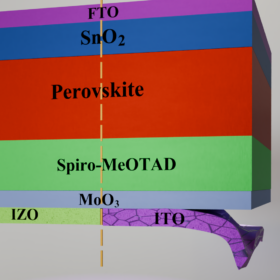
Highly transparent perovskite solar cell achieves 18.22% efficiency
A research team in India has investigated the use of highly conductive transparent electrodes based on amorphous indium zinc made with a room temperature process in perovskite solar cells. The devices could be used in tandem and building-integrated PV applications.

JinkoSolar achieves world record efficiency of 27.79% for TOPCon solar cell
The Chinese manufacturer says Germany’s Institute for Solar Energy Research Hamelin (ISFH) has independently verified the result.
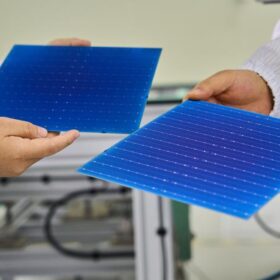
New research sheds light on passivation-related defects in heterojunction solar cells
Korean researchers revealed that efficiency losses in heterojunction solar cells arise from two coexisting defect types – dangling bonds and weak silicon-silicon bonds. Their findings explain how hydrogenated amorphous silicon passivation help mitigate these defects and improve cell performance.
