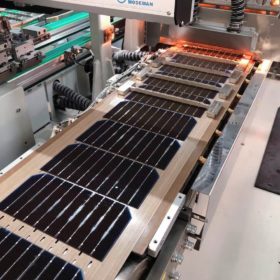
Half-cut, bifacial, 20.5%-efficient PERC modules from Vietnam
Chinese solar manufacturer Dehui is planning mass production of 12-busbar bifacial panels based on 182mm wafers from next year.
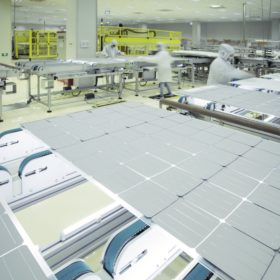
Chinese PV Industry Brief: More ingot and module capacity, China’s largest rooftop project and a possible new listing
A new week has brought another slew of big production capacity announcements as online retailer JD.com prepares to install 200 MW of solar rooftop capacity and project developer SFSY reported on a promising new business stream.
Perovskite solar cell based on metal-organic framework with 22.02% efficiency
Scientists in Hong Kong have developed a cell they say retains more than 90% of its initial efficiency under accelerated testing conditions. The device is based on two-dimensional metal-organic frameworks.
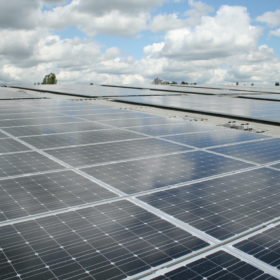
Chinese PV Industry Brief: 1 GW of distributed solar came online in August
More than 1 GW of subsidized small solar arrays were installed in China last month alone and manufacturer Suntech has announced the start of operations at its 500 MW Indonesian cell and module fab.
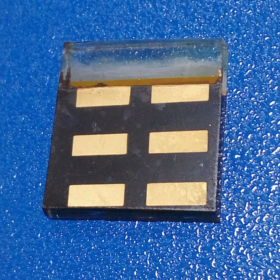
New molecular precursor for kesterite solar cells
Scientists in India have developed a new molecular precursor for applications in kesterite solar cells. They used the precursor to build a superstrate type solar cell with an efficiency that is purportedly among the highest ever recorded. They relied on a low-temperature process to manufacture the device.
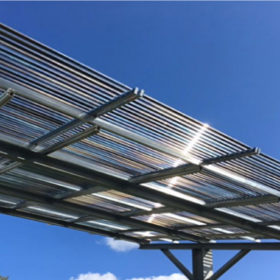
Thin-film agrivoltaic solar tubes
German tech company Tube Solar AG has secured €10.8 million to develop its cylindrical agrivoltaic modules. The lightweight devices could also be used on roofs until now considered unsuitable for PV.
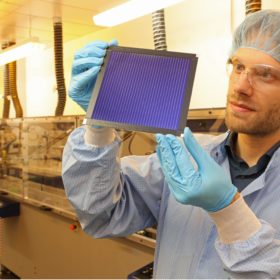
New world record for large-area organic PV module efficiency
Scientists in Germany have achieved 12.6% efficiency with a 26 sq cm organic panel and 11.7% for a 204 sq cm device. The feats were achieved with a new module layout and a slower, high-resolution, short-pulse laser structuring process.

Polish solar manufacturers unite to compete with imports
Businesses, supported by the government, will join forces to strengthen their industry and contribute to the European Green Deal through made-in-EU products.
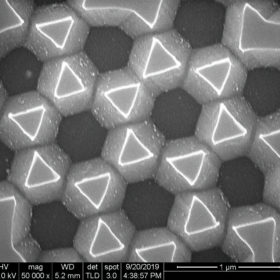
Nanostructures for ultrathin flexible wafer
Scientists in South Korea combined two processes to etch a nanostructure of tiny pyramids onto the surface of a silicon wafer. As well as trapping more light and increasing the cell efficiency, the group claims that its nanostructure improves the mechanical flexibility of the cells. This could potentially allow for the use of much thinner silicon wafers than is currently possible in production.
Cooling PV panels with seawater
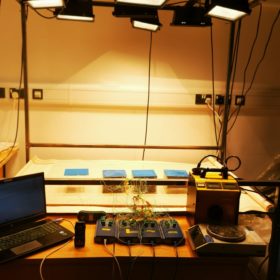
An Anglo-Egyptian research group has developed a passive cooling method based on saturated activated alumina, with saline water as a cooling agent.
