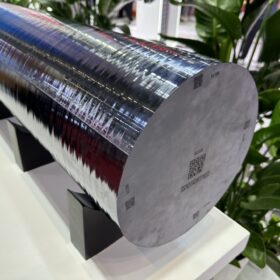
New US rules support solar supply chain, manufacturing
New US incentives support solar manufacturers and encourage the domestic build-out of the earlier stages of the solar supply chain.
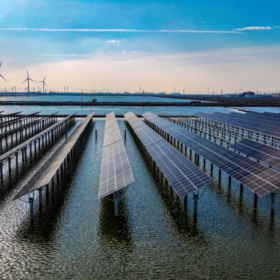
Chinese PV Industry Brief: China adds 160 GW in January-September period
China’s National Energy Administration (NEA) says solar installations reached 160 GW between January and September 2024, with cumulative capacity hitting 770 GW by August.
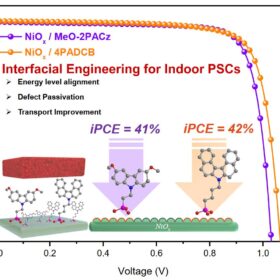
Indoor perovskite solar cell based on self-assembled monolayers achieves 42% efficiency
Researchers in Taiwan have developed an efficient carrier transport and defect passivation approach at the nickel oxide/perovskite interface in perovskite solar cells, enabling devices with 42% efficiency under indoor lighting conditions, and over 20% in simulated sunlight.
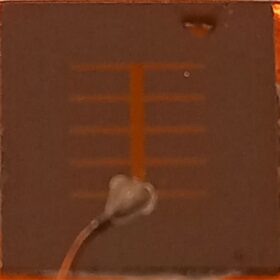
First attempt to build solar cells based on gallium phosphide, titanium
After conducting theoretical studies on gallium phosphide, titanium solar cells for years, a group of Spanish researchers has now sought to build the first intermediate band device based on this material combination and has found it can achieve enhanced external quantum efficiency at wavelengths above 550 nm.
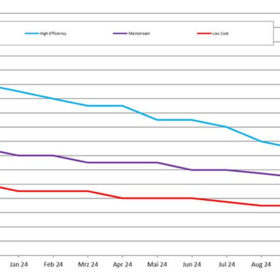
TOPCon solar panel prices falling in Germany amid industry struggles
Martin Schachinger, the founder of pvXchange.com, reports that tunnel oxide passivated contact (TOPCon) solar module prices in Germany have fallen by an average of €0.010 ($0.0109)/W this month. Demand remains especially weak in the residential sector, while complex authorization processes are also challenging the commercial and industrial (C&I) and ground-mounted segments.
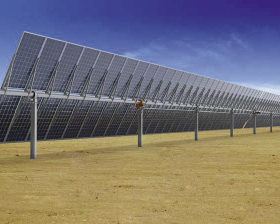
Chinese PV Industry Brief: Arctech secures 2.3 GW tracker order in Saudi Arabia
Arctech Solar says it has signed a 2.3 GW tracker order from Saudi Arabia, where it will supply trackers designed for the region’s desert terrain and high winds.
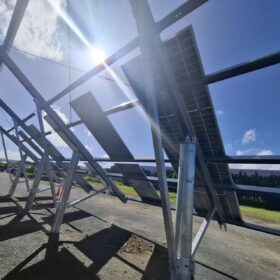
JinkoSolar, Trina say TOPCon modules outperform p-type back-contact panels
JinkoSolar and Trina Solar have separately reported that on-field testing shows tunnel oxide passivated contact (TOPCon) solar modules outperform p-type back-contact PV modules in monthly power generation.
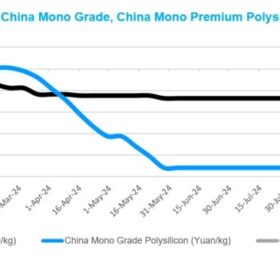
Polysilicon prices remain stable ahead of U.S. Department of Commerce’s anti-dumping ruling
In a new weekly update for pv magazine, OPIS, a Dow Jones company, provides a quick look at the main price trends in the global PV industry.
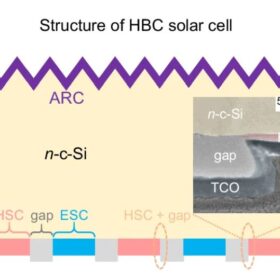
Longi reveals details of 27.09%-efficient heterojunction back contact solar cell
In a new paper published in nature communications, the Chinese solar manufacturer explained that the heterojunction back contact cell it unveiled in late 2023 achieved one of the highest open-circuit voltage ever reported for this cell technology, as well as smaller than usual short-circuit current losses. The results were confirmed by Germany’s Institute for Solar Energy Research (ISFH).

Grid defection is profitable in some solar-rich U.S. locations
Researchers from Canada’s Western University assessed eighteen case studies across thirteen US states and found in areas an economic case for disconnecting from the electricity grid in some areas with high solar irradiation and high electricity rates. They say economic grid defection and utility death spirals are becoming salient issues in the US.
