
Chinese PV Industry Brief: Solar manufacturers report strong financial performances
JA Solar, TCL Zhonghuan, GCL Tech, and Ganfeng Lithium all announced increasing profits and revenue. Meanwhile, JinkoSolar expands its hydrogen business and Xinte Energy secures another big polysilicon supply deal.
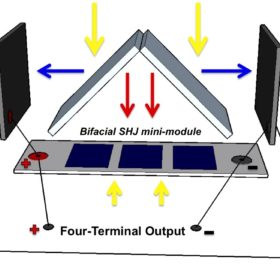
Four-terminal multijunction approach for bifacial modules
Scientists tested bifacial PV devices based on silicon and gallium arsenide cells connected in a four terminal layout. They note that the four terminal design offers significant advantages over more common two terminal devices, allowing for a 17% (relative) increase in efficiency thanks to better absorption of light reaching the rear side.

Study confirms rule of thumb that PV inverters should run without faults for around 15 years
A new study by Bern University of Applied Sciences shows that the performance of most PV inverters and power optimizers remains optimal for up to 15 years. The inverters considered came mainly from the manufacturers Fronius, Sputnik, and SMA and most of the power optimizers examined came from Solaredge.
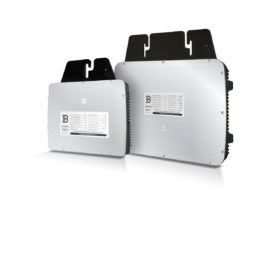
New micro-inverter series from China
Beny Electric unveiled a micro-inverter series with efficiency of up to 97.5% and a European efficiency of up to 97%. The micro-inverters are available in three different versions with a rated power output of 550 VA, 700 VA, and 2,800 VA, respectively.

Switzerland deployed 683 MW of solar last year
This year the Alpine country should see the deployment of up to 900 MW of new PV capacity. At the end of December, cumulative solar installations reached 3.65 GW.
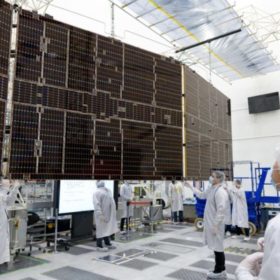
Solar panels power the largest optical telescope in space
Our deepest view into the universe is powered by PV. NASA was one of the earliest adopters of solar technology, and it continues to be an important feature of spacecraft today.

Tata Power to build 600 MW wind-solar hybrid plant in India
The plant will be located in the state of Karnataka and should be completed within 24 months.
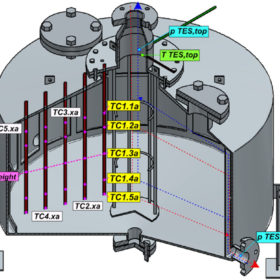
Storing renewables via radial-flow packed bed thermal energy storage
Researchers in Sweden have created a thermal energy storage system relying on a dynamic air mass flow rate that is applied during both charge and discharge processes. It achieved a maximum thermal efficiency of around 70%.
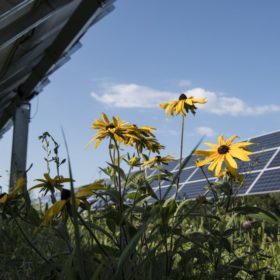
Novel method to turn existing solar parks into agrivoltaic facilities
An international research team has developed a new methodology to increase levels of pollination at ground-mounted solar plants. It involves the development of new vegetated land cover below and around solar parks.
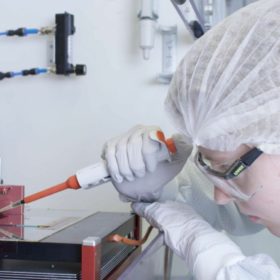
Eco-friendly solvent for a 16.7% perovskite solar cell
Scientists in Germany looked to eliminate the use of toxic solvents in the production of perovskite solar cells, replacing them with a more environmentally material called dimethyl sulfoxide (DMSO) which has so far proved difficult to integrate into processes suitable for large-scale production. The group demonstrated a scalable blade coating process using DMSO as the only solvent, and reached cell efficiencies close to those achieved using more toxic substances.
