
Australia’s ‘largest’ solar facade
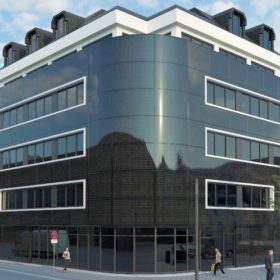
Victorian-based property developer Beulah has announced its soon-to-be-completed Paragon tower, in the heart of Melbourne, will be home to the nation’s largest and most efficient vertical solar PV system.
PPA for PV facade in Germany
A 50 kW PV system is being built on the facade of a radiology center near Marburg’s main train station. The Marburg municipal utilities and the Sonneninitiative association have concluded a PPA that ensures the long-term financing of the project.
Assessing potential of facade PV modules
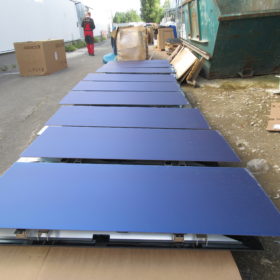
A new building at the Helmholtz-Zentrum Berlin (HZB) is being covered with facade CGIS solar panels provided by German manufacturer Avancis. A research team will analyze their performance and special features, including new sensors for incident radiation and heat.
CdTe facade solar panel with 18.2% efficiency
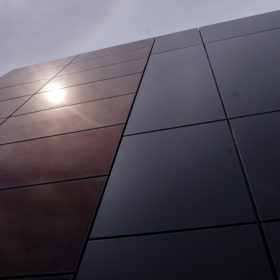
New cadmium telluride solar panels are now available for applications on tall buildings in urban environments. Their efficiency ranges from 15.3% to 18.2%, with 110 W to 450 W of power output.
Facade solar panels with ‘mimic design’
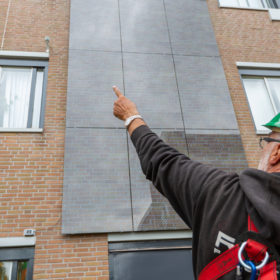
Dutch startup Solar Visuals and the Netherlands Organisation for Applied Scientific Research (TNO) have developed new “mimic design” facade modules that reproduce the features of building surfaces. Lenneke Slooff-Hoek, a senior scientist for TNO, told pv magazine that the panels can be made in any size or color at 13% efficiency, adding that they have a partly transparent colored layer made of small dots.

New PV system for facades, windows in Japan
Japan’s Kaneka and Taisei have designed their T-Green Multi Solar system to be integrated into walls and window surfaces. The system is available in two different versions – a solid type in which PV laminates are turned into vertical exterior panels or walls, and a variant that achieves transparency through striped solar cells that are integrated into window glass.
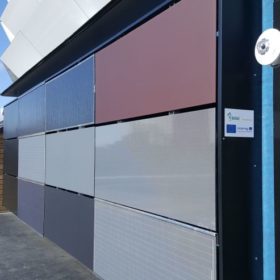
Colored PV module performance is underestimated
In a recent conversation with pv magazine Roland Valckenborg, business developer and project manager at the Netherlands Organisation for Applied Scientific Research (TNO), has described the results of a multi-year testing program for colored BIPV modules. Just a few years ago, it it was thought that power yield could be up to 50% lower than conventional panels, but tests have shown a difference of just 10%. Valckenborg says that losses can vary depending on the color of a panel.
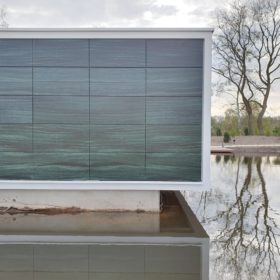
Wood-like solar facades
Taiwanese manufacturer Heliartec Solutions is offering BIPV panels for building facades that can be designed to mimic different kinds of textures in conventional building materials. The panels can also work as colored laminated safety glass and replace traditional cladding in the ventilated facades of buildings. They vary in length from 60 cm to 240 cm, with widths ranging from 30 cm to 120 cm. Depending on their size, the panels can offer power outputs of 90 W to 150 W per square meter.
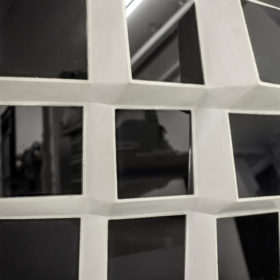
German scientists develop solar facade with 50% higher yield
The three-meter prototype consists of nine panels based on an aluminum compound. The PV elements of the facade can be tilted to capture more sunlight.

The weekend read: Past the Arctic Circle, one degree at a time
Solar has a small but increasingly important role to play in the Nordic energy transition. And while there is still a gap in PV cost-competitiveness across some markets, interest in solar facades, BIPV solutions and C&I applications is growing.
